From Foxtrot to Freestyle
Dancing with an alternative logic for complex change

Complex issues in society require a different logic than the logic and methods used so far. Is it really the experts, policy-makers and trusted institutions from whom we can expect this different logic? At least in project ‘De Ader’, (The Vain) those involved did not wait for this answer. They wanted it to be different and they did do things differently.
Frank Crucq and Suzan Lindhout are lecturers in Leisure & Event management at Breda University of Applied Sciences.
As the initiator of ‘De Ader’, Dansnest (Dance hub) has experienced in previous community art projects that there are a lot of ‘by-products’ when working on an art project in a neighbourhood. In addition to the social and artistic value of these projects, requests for help, talents, health questions and financial (im)possibilities were also revealed. But as a stand-alone organisation, in this case a dance company, you cannot take on all the societal roles to adequately respond to these by-products. From this experience, ‘De Ader’ was set up as a collective with five equal partners each with their own interests:
- Dansnest: creating a dance performance with residents to explore in the process what it means to be currently connected in South-West Breda.
- Surplus Welzijn: increasing social cohesion in the south-west part of Breda, get in touch with people in the neighbourhood who are off the radar.
- Wij: connecting with others and increasing networks to encourage self-reliance for the elderly.
- Nieuwe Veste: enabling everyone in Breda to participate in cultural events.
- Breda University of Applied Sciences: having students and staff collaborate in practice to learn about the changing power of dialogue.
Starting in 2023, these five partners decided to explore in practice how dance can serve as a means of strengthening social networks of vulnerable groups in the south-west of Breda.
Different logic
In a traditional approach to a complex question such as this, the first thing that is often determined is who is responsible for a solution. Is it the municipality and if so, which department? Or are the residents themselves responsible? Or a care organisation? Then an analysis is made and a plan is created. Traditionally the process is that when there is a problem, professional expertise is called in, and a solution is offered based on that expertise. According to complexity expert Dave Snowden, this is an example of a complex problem, where many variables are constantly affecting each other and the problem is constantly changing and it is approached with a specialist approach. A specialist approach assumes a clear relationship between cause and effect that requires specialist knowledge to understand.
I cannot dance, but my wife can, she also enjoys Zumba and such. I will pass her the flyer. There are not too many handsome men there, are there? (man at the pool table).
However, complex matters are characterised by the fact that these relationships cannot be clearly analysed at all, but rather, can only be understood experimentally or even in retrospect. That is a different logic and requires a different approach. By carrying out specific experiments and seeing what their impact is, the next step is determined. So, you do not know in advance what the solution is going to be.
De Ader
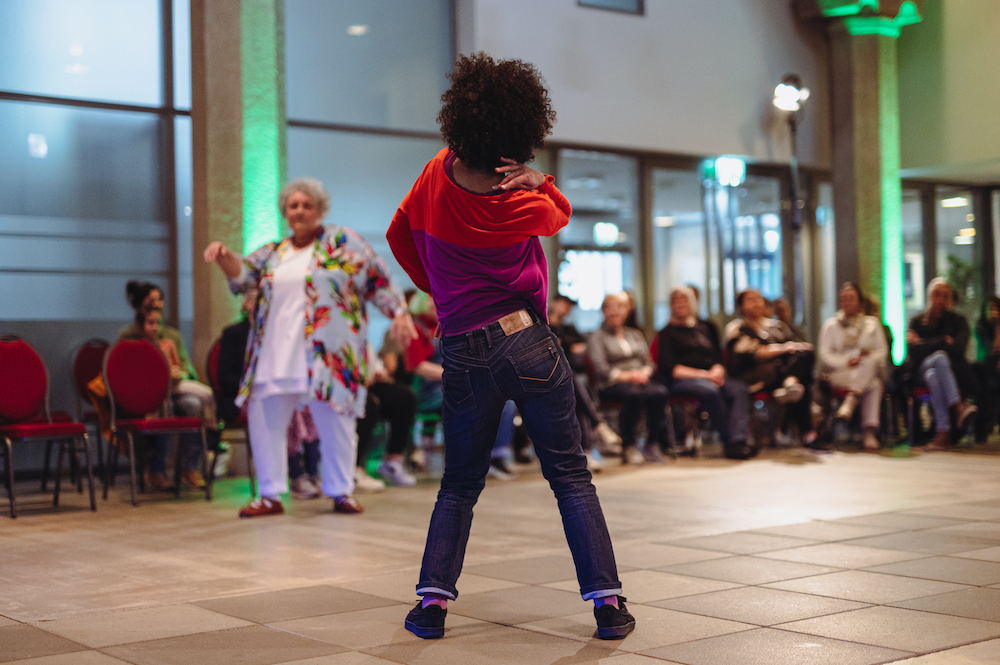
Project ‘De Ader’ was designed from that logic. The specific experiment was always ‘dance’. At different places and times, dance was initiated. There was dancing by performers in a residential complex, the elderly were encouraged to dance by coaches, directors of institutions danced with their own target audience, girls danced for empowerment, and there was a public choreography exercise in a square. This dancing brought people together. Some came back, others watched from a distance, and still others took people with them the following time.
These dance interventions were foreign to many. It raised the question ‘what is happening here and how do I relate to it?’ For example, for Kees who was bothered by the social distancing during the Covid pandemic. It had been a long time since he made conscious physical contact with others again. He felt connected. He was surprised that this felt so easy. And another participant mentioned: "This is not a dance! This is moving to music. Dance is foxtrot, Viennese waltz, Rumba.” After talking briefly about what dance has to do with self-expression and connections in addition to movement, "actually I dance all day, it just depends on what your definition of dancing is?!”
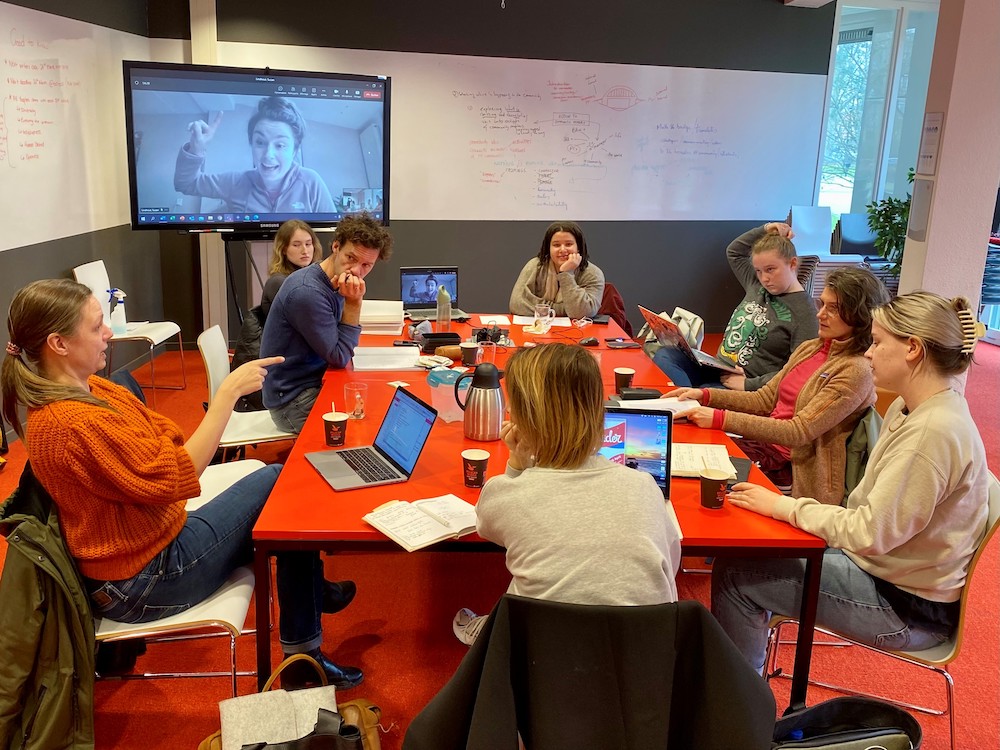
These experiments provided a connection, and by listening to what residents wanted to bring in, initiatives emerged from within themselves that were supported by partners. To expand that process, the partners in the project met weekly. These meetings always focused on three questions: ‘what visibly happened?’, ‘what do we want to happen?’ and ‘what can we offer?’ All partners provided their perspectives on those questions, and so new steps could be taken to connect more people. In addition, Performatory (BUas) students facilitated reflection dialogues to zoom out further and explore new directions.
A different working method
This was an unusual working method for all partners. Apart from the confusion and ambiguity it sometimes caused, it also brought value:
- Instead of thinking in plans, it was now mainly about thinking in terms of what each partner could add from within their own organisation. Frank Weijters (Surplus) contributed his direct knowledge of the neighbourhood: families which could be involved, available meeting rooms, etc.
- The different perspectives of the partners gave rise to creativity and the ideas were applicable immediately. To more deeply understand what is going on in the neighbourhood, for example, students developed methods for retrieving stories from the neighbourhood. A mixture of culture, welfare and leisure also emerged: each week, a residential complex simultaneously hosted coffee, dance, choreography and social care.
- A strong collective and informal accountability emerged. Work, appointments and responsibilities were prompted not from systems, but from a personal loyalty to the project.
- Instead of looking at problems in the neighbourhood, the focus was on opportunities. This approach, underpinned by ‘Appreciative Inquiry’, generated a lot of positive energy.
Impact
So, what is the impact of such an approach? There are many different answers to this question. Often with a complex problem, you do not even know what the problem is, let alone the impact you envisage. From January to May 2023, there were several experiments and follow-ups:
- Eight morning dances, starting with eight and ending with 30 residents, students and professional dancers.
- Five dance meetings, of 20 residents each time in a social housing building.
- Eight dance classes for ten girls with youth work.
- Two months of choreography in a public square (dozens of passers-by participated).
- Two presentation days with all dance activities. Several dance groups presented their choreography. Closing dialogue between 160 dancers, audience and residents.
- Social media: 20,000 hits.
But beyond the actual events, the project is very much about the lifeworlds of those involved.
For residents: "My wife passed away, I have only lived here for a year. I did not know anyone and felt lonely. Now I belong somewhere, I belong with this group. I am not much of a dancer, but I can just participate in my own way” (Ben 75+).
A great example of how dance and gatherings reinforce each other; true inclusion and diversity (Marianne de Bie, former alderman for Culture in the City of Breda).
And for professionals: "This touches on all kinds of topics: intimacy, finding your place, fun and wonder. We come from different places, we have different backgrounds, ages, but we hear the same music. With dance, special conversations arise without words and everyone can be a part of it” (Ineke van Dijk of Nieuwe Veste).
Operating principles
Looking back on this method, we see the following guiding principles:
- Be open to the people, ideas or events which present themselves. This requires time and presence in the neighbourhood.
- Organise the team and communication in such a way that you can act quickly and in a flexible manner.
- Gather immediate knowledge around you. Assemble a team with a wide range of knowledge: practical, artistic, local, social and theoretical.
- Involve policy-makers in practice so that trust in this open approach increases.
- Find moments where ‘it works’, where you see the potential in people, places or experiments. Build on that and follow that energy for a positive atmosphere and easy follow-through.
More information
https://deaderbreda.nl/