Sports and Exercise scenario study
How can the indoor sports facilities of the municipality of Westerveld become more future-proof?

The leisure industry is influenced by what happens in society. This impact may take a while, such as the gradual ageing of the western population. Such gradually (sometimes even imperceptibly) increasing forces are also called stress factors. But Covid-19 has also shown that suddenly something unexpected can happen which can affect the industry considerably. These are referred to as shock factors or black swans or, in severe cases, disruptions. As a company or an organisation, you can try to guard against the effects of future influences in advance, by spotting them early and taking measures which reduce vulnerability to such developments. If you can manage that, you become more ‘future-proof’.
Albert Postma, professor of scenario, European Tourism Futures Institute (ETFI), NHL Stenden University.
Prediction or exploration
Unfortunately, we do not know that much about the future, especially when it is a bit further away. Most of the knowledge we have is about the past, while the goals we set, and the plans we make, are always about the future. In order to anticipate what awaits you as a company or organisation in the coming years, you would actually want to be able to look into some kind of crystal ball. Future scenarios serve as such a magic ball, so to speak.
Often, many people think of scenarios as predictions of the future. But in fact, the chances of the predictable future actually becoming a reality are zero. All kinds of developments and events we do not know about may cause society to develop in unpredictable ways. The future is not as unambiguous as it may seem. Due to the dynamics of a complex interrelated social force field, the future may evolve in a variety of ways. Scenario planning involves exploring and describing these alternative futures in extreme but imaginable and recognisable storylines which take place in the future. It should be noted that these scenarios are explicitly not predictions but explorations of what might happen. Together, the alternative scenarios represent the boundaries of how the realm of businesses or organisations evolves. Thorough consideration of the scenarios provides a picture of longer-term opportunities and threats. Through the timely inspiration of vision, policy, strategy, business concept, business model, etc. using these insights, greater future-proofing is achievable.
Most knowledge is about the past. Goals and plans are always about the future.
Social structure vision of the municipality of Westerveld
The municipality of Westerveld in Drenthe also considered this a few years ago, when it was about to draft a new social structure vision (structure vision focused on the social domain). The municipality of Westerveld is located in the western part of the Drenthe province on the territory of the national parks Dwingelderveld and Drents-Friese Wold. The municipality consists of 26 villages with about 19,000 inhabitants and 8,300 households. Its main population centres are Havelte, Diever, Dwingeloo, Vledder and Uffelte.
An important idea for the new social structure vision was that sports and exercise can provide an important contribution to the quality of life in the municipality because it may connect art, culture, welfare and education.
Within sports and exercise, indoor sports facilities play an important part. They are often freestanding in the village centre and some even perform the function of a village hall or are connected to it. The municipality of Westerveld has two sports halls, a sports centre, two gyms or fitness centres, and a number of, often older, school gyms. Due to the decline in the use of the facilities, they have gone into a downward spiral in terms of operation and management. The question the municipality asked the European Tourism Futures Institute (ETFI) is how to future-proof indoor sports facilities. The scenario study conducted by ETFI in 2018-2019 had four phases: an internal analysis, an environmental analysis, scenario development and its translation into policy implications.
Scenario study of indoor sports facilities
The internal analysis focused on supply and demand for indoor sports facilities in the municipality and how the municipality influences them with sports and exercise policies. For example, the profile of residents (lifestyle and vitality profile), the use of indoor sports facilities, residents' familiarity with the offered facilities, the municipal policy regarding the facilities, and the policy to encourage sports and physical activity were examined. This initial study was carried out on the basis of policy documents, interviews with the alderman, policy officials involved and exercise coaches.
For the environmental analysis, the researchers delved into existing studies, reports, policy papers, and so on. The identified relevant demographic, economic, social, technological, ecological and political changes and developments which will influence the demand for and supply of sport and exercise in the coming years. Thus, developments in sports demand and sports participation (sports participation, types of sports, individualisation, group behaviour, the role of the traditional sports clubs/associations, role of the distance between home and accommodation, liveability of the neighbourhood) were examined; developments in requirements for operation and management (regulatory pressure from national government, government spending, performance management, diversity of supply, broadening the tasks of sports clubs), the developments regarding sports clubs (membership numbers, membership fees, availability of volunteers, and broadening of the social tasks (consider social integration, health promotion, education, promoting liveability, or changing lifestyle)). The cohesion between the inventoried developments was analysed, resulting in seven forces which are likely to drive changes in the market of supply and demand until 2030, which are referred to as drivers of change.
Driving forces
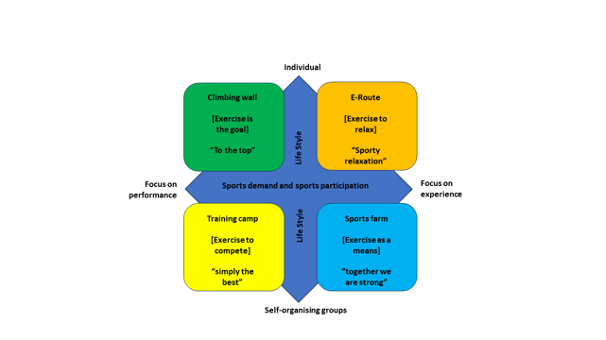
During the scenario development phase, two of those driving forces were identified during a workshop by stakeholders as most influential and at the same time least predictable. These two core uncertainties formed the basis for framing four scenarios. The two core uncertainties were: sport demand & participation and lifestyle.
‘Regional characteristics’ and ‘elderly’ were seen as relatively predictable driving forces. What is special about these kinds of elements is that they will occur in each of the future scenarios, but always in a different context. Finally, there are three other driving forces which workshop participants believe have limited influence relative to the others for future developments. These are ‘operation of sports clubs’, ‘technology’ and ‘national policy’.
The wise choice is to draw inspiration from all four scenarios simultaneously.
Four scenarios
Of the two core uncertainties, two conceivable extremes in which those uncertainties could develop between now and 2030 were identified. When both core uncertainties showing the most extreme cases are drawn as two perpendicular axes, a ‘scenario graph’ emerges which provides the framework for four scenarios (Figure 1). Using free association and the necessary imagination, the four scenarios were explored in more detail and finally articulated in a consistent and imaginative story which outlines the future regarding sports and physical activity. Each of the scenarios has been given an appropriate title and a distinctive .
Advice
During the final phase of the study, we, together with the municipal council committee, reviewed what would be the desirable and undesirable consequences of each scenario in 2030. Following this meeting, ideas were provided by ETFI to anticipate the most important desires and unwanted outcomes.
The overview of ideas for each scenario indicates the types of accommodation and facilities needed (product range) and the forms of management and operation (role of the municipality versus commercial parties, citizen participation, revenues). The relationship with arts, culture, education and welfare is also described. Finally, the alignment of the scenarios with the municipality's current residents' vitality profile is mentioned.
The advice to the Westerveld municipality was to not focus on just one of the scenarios. Gambling by focusing municipal policy on one scenario could turn out to be ineffective when society evolves in a different manner. The wise choice is to draw inspiration from all four scenarios simultaneously. Only then can robust policies stand the test of time. Temporarily, that is. Today's complex and dynamic society calls for permanent monitoring of the forces involved, and periodically reviewing the analyses, the core uncertainties, the scenarios and thus also the policies based on them, and adjust them when necessary.