A look into the future of placemaking
With leisure as a key component

Leisure has an important relationship to time, space, and place. In leisure studies we are used to thinking about time as the basic resource for leisure. We need leisure time in order to be able to enjoy leisure, and so the struggle for leisure time has been an important focus of leisure research.
Greg Richards is Professor of Placemaking and Events at Breda University of Applied Sciences.
But in addition to time, leisure also requires space. This is very obvious when we think about leisure undertaken in nature – we need to conserve natural spaces in order to allow people to experience nature. Nature needs space to be able to flourish. This applies to urban environments as well, where parks and other public spaces provide a vital leisure resource. We also need space in our own homes for leisure – with the growing range of fitness equipment and digital technology to support leisure activities we need an increasing amount of space in our attics and living rooms.
Space and place
Leisure activities not only take up space, but they also importantly and literally ‘take place’. In very simple terms, a place is a space which is given meaning through activities and events. Our home is not just a space to live in, but a place where we feel comfortable, where we are surrounded by people, memories and objects that are meaningful to us. The same applies to our neighbourhood or our city – we become attached to such places because they provide us with meaning. The place where we grew up, the school we attended, the place we work, and so on.
In addition to time, leisure also requires space.
The act of giving meaning to space is what placemaking is all about. Meaning can be generated for and by places because they are economically important, socially important, symbolically important, and so on. Places are important because they enable people and communities to thrive and to enjoy a certain quality of life: "Placemaking is the process of creating quality places that people want to live, work, play and learn” (Wyckoff, 2014). Richards (2020) summarises the placemaking process as the outcome of three important aspects of place: the physical and intangible resources found there, the ways in which people attach meaning to those resources, and the creativity required to develop systems that will support the quality of life for all.

The concept of placemaking is also changing, from a focus on physical aspects of places, with placemaking initiatives being largely led by planners and architects, to a much broader concept of placemaking as a combination of tangible and intangible change that involves the whole community. There are several challenges in the definition and implementation of placemaking strategies.
Multifaceted placemaking
Placemaking is a very broad concept, involving all aspects of life and therefore all aspects of leisure. Placemaking processes are also subject to the same general societal trends as other areas of life. The main challenges for placemaking therefore include issues such as the energy transition, the circular economy, housing supply, inclusivity, and the rise of digital technologies. Meeting these challenges involves not just physical planning, but also the need to give new meanings to places. This principle is now enshrined in the Dutch Government’s long-term vision on the future development of the living environment in the Netherlands. The Dutch National Strategy on Spatial Planning and the Environment (NOVI) requires local government to produce an environmental vision setting out how the available space will be organised and managed to deal with future challenges to 2040.
One important consideration in the implementation of the NOVI is how spatial equity might be achieved. The strategy sets out three important factors to be taken into consideration in weighing different interests in the use of space:
- Combined functions are more important than single functions
- Characteristics and identity are central
- Avoid shifting the problem to other areas
This implies that in the future, leisure will be increasingly involved in the multifunctional use of space and that it will be an increasingly important tool to develop and support the identity of places. The need to ensure inclusivity and multiple use means that we need to consider not just the division of leisure space between different target groups, but how we can give leisure places multiple meanings. Place meanings will increasingly need to be based not on a closed and static idea of identity, but on concepts such as Turkish author Elif Shafak’s "multiple belongings” that enable us to understand and share places in a flexible way. Shafak (2019) argues that identity, and therefore our relationship with place, is not fixed, but a fluid set of relationships, or stories people tell about themselves. These stories should bring us closer to – rather than divide us from – our fellow human beings.
A place is a space which is given meaning through activities and events.
Shafak’s optimistic vision is born of movement between multiple cultures and multiple locations, which necessitates opening up to difference and change. But she argues that multiple belongings can also be developed in situ, also through leisure: "Through your family stories, cultural affiliations, social preferences, political views, sports and arts connections, and so on, you still have multiple belongings.” As space for leisure becomes increasingly scarce, it will be important to develop positive stories that facilitate the multiple use of places.
Rather than stick to traditional ways of making places to fit specific uses, or the design of ‘multifunctional leisure spaces’, the development of multiple belongings to leisure space depends on developing stories about the different uses and meanings of spaces. This becomes easier in a leisure context, because the emphasis is placed on the unconstrained and flexible use of space, rather than heavily defined, exclusive and economically charged spheres of work or ‘essential services’.
Developing creative placemaking
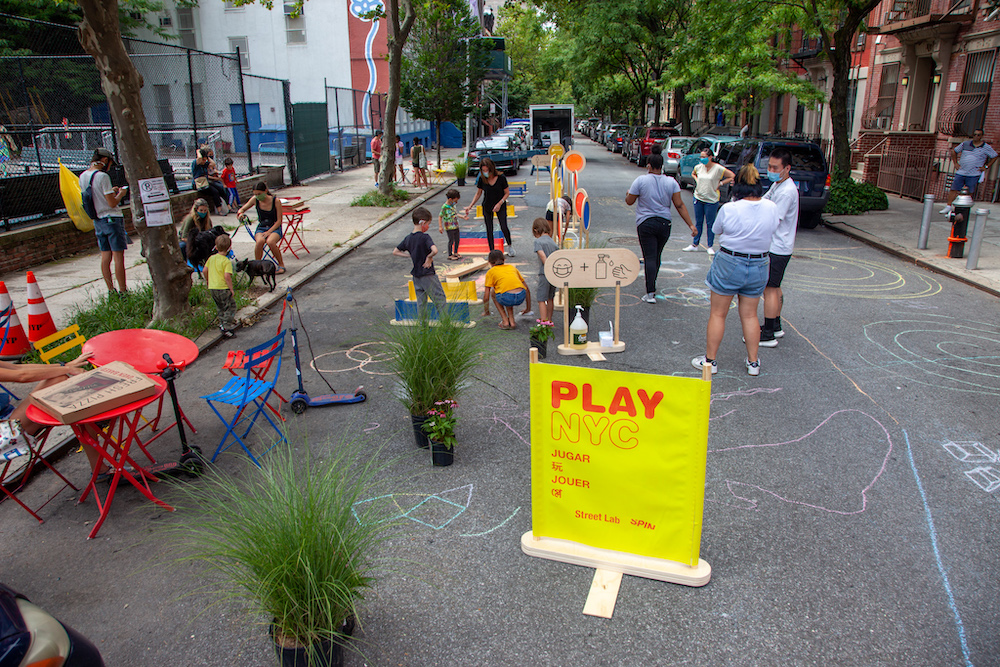
Even before Covid, events such as Park(ing) Day were re-thinking the use of parking spaces as leisure space. Park(ing) day is "a global, public, participatory project where people across the world temporarily repurpose curbside parking spaces and convert them into public parks and social spaces to advocate for safer, greener, and more equitable streets for people.” The event began in 2005 with the transformation of a single parking bay in San Francisco, but by 2011 had grown into a global movement, encompassing almost 1,000 sites in 128 cities (Richards, 2015). This is an example of placemaking as tactical urbanism: "The purpose of this event is not to permanently reclaim parking spaces for public use. This is not an Occupy movement, or a sit-in. Rather, it is a temporary project, the goals of which the organisers define as” to promote creativity, civic engagement, critical thinking, unscripted social interactions, generosity and play” (Barber, 2013: 21). These types of events therefore not only use space for leisure purposes, but also have leisure outcomes. At the same time, they challenge people’s perceptions of the ‘right’ use of space, and the ‘right’ of different groups to occupy space. These are important discussions that lay the basis for tackling the major challenges ahead.
In many cities we are seeing an increased use of rooftop spaces for leisure and for other purposes. For example, the Portuguese city of Faro organised the Açoteia Rooftop Festival in 2019, giving residents and visitors a new view of the city and generating considerable publicity. This led to the formation of the European Creative Rooftop Network, which aims to "develop and share new methods for the sustainable and collaborative management of rooftops in Europe” which includes much bigger cities, such as Rotterdam and Amsterdam. Stichting Roef in Amsterdam argues that rooftop activities are needed because "Only 2% of Amsterdam rooftops is utilised; Just 1% of flat roofs is vegetated; The city is still growing busier; and Green is essential in battling climate change”. The total roofscape of Amsterdam is around 12 square kilometres, or 25 times as large as the Vondelpark. The Amsterdam rooftops are therefore becoming leisure spaces: "Get away from the daily hustle and bustle and enjoy the view. Read a book or have a drink in one of the city’s roof parks, green terraces, public food gardens, and other public spaces”.
The annual Rooftop Festival shows the potential of leisure events for placemaking. The 2022 edition of the festival included programming from Holland Festival, Fringe Festival, Julidans and IDFA, showing the potential of these ‘new’ spaces to become part of the event programme of the city. The future vision of Stichting Roef is even more ambitious, envisaging "Holland’s biggest rooftop park, connected by footbridges, allowing you to go from roof to roof to roof!”
Meeting future challenges
Such tactical placemaking can be applied to new designs as well. Danish architects Third Nature have responded to the challenge of climate change by designing flexible parking solutions. Their pop-up garage design solves three challenges at the same time. When heavy rain falls, stormwater fills the underground reservoir, pushing the floating underground car park to the surface. The emergence of the car park into the cityscape highlights the adaptation to the forces of nature:
"Cities are in extreme situations where billions need to be spent on climate mitigation solutions and the equivalent amount on handling densification of the cities, especially the conflict between cars and urban spaces, so for us it is natural to think of the solutions together. It is a serious game with the infrastructural systems that provide real viability and completely new types of experiences back to the city’s users” (Flemming Rafn Thomsen, partner at Third Nature).
As Marques and Pimentel Biscaia (2019) suggest, by linking leisure and placemaking, in cities in particular, leisure can contribute heavily to a healthier, happier, and more balanced way of living, by providing the flexibility needed to change uses and meanings.
In many cities we are seeing an increased use of rooftop spaces for leisure and for other purposes.
Another extension of placemaking in the future will be the design of the virtual world. Emerging virtual environments such as the Metaverse and Decentraland may in the future provide alternative leisure spaces that can help to increase the sustainability of physical leisure places. Building new virtual places that are attractive for leisure will also require ‘digital placemaking’, which entails turning digital space into place by creating meanings for those spaces and therefore generating a digital sense of place. One of the biggest challenges in digital placemaking is to produce a digital sense of co-presence, as Meta suggests: "the metaverse will help you connect with people when you aren’t physically in the same place and get us even closer to that feeling of being together in person”.
Meta showcases the development of skating community in the metaverse by Melissa:
@bronxgirlsskate, a growing community where girls are finding their place in #skateboarding. With the support of Melissa’s skate crew from the Lower East Side to the Bronx and beyond, the only thing she’s limited by is her imagination. All over the world skaters like Melissa use our technologies to build community and make the sport more open and inclusive. With more access to the sport and each other, skateboarding makes its official debut at the Olympics. We change the game when we find each other.
In Decentraland, a wide range of leisure events and attractions are springing up, such as is the Museum of Contemporary Digital Art (MoCDA), which "provides digital art education and technology to artists, collectors, institutions and art lovers”. There is also a Metaverse Fashion Week 2023 and a Metaverse form of Amnesia Ibiza nightclub.
Emerging virtual environments may in the future provide alternative leisure spaces.
To make these digital places engaging for visitors, digital placemaking will need to adopt similar strategies to physical placemaking, ensuring that the digital resources are turned into meaningful places through the application of creativity. It will be important to ensure the development of digital co-presence, in order for participants to share a common focus and generate emotional energy.
Conclusion
The future of placemaking arguably needs to be grounded in addressing future challenges, allowing leisure practices to adapt to the changing context. For this to happen, more participative modes of placemaking should be developed that involve leisure as part of the process, rather than simply a design output. A number of projects, such as the EU-funded SmartCulTour initiative, are using ‘serious games’ to help planners, residents and other stakeholders co-create solutions to problems such as inner-city tourism management. The fact that the discussion of serious issues is contextualised as leisure, as a game, means that much of the edge is taken off potential conflicts.
Sources
- Richards, G. (2020) Designing Creative Places: The role of creative tourism. Annals of Tourism Research. https://doi.org/10.1016/j.annals.2020.102922
- Shafak, E. (2019). As Human Beings We All Have Multiple Belongings. https://www.berggruen.org/ideas/articles/as-human-beings-we-all-have-multiple-belongings-elif-shafak/
- Wycoff, M.A. (2014). Definition of Placemaking: Four Different Types. Planning and Zoning News.
Photography
- www.stefanoborghi.com (page 53)
- Street Lab (page 55)