How Big Data is going to change the leisure industry
From insight to experience with Digitwin

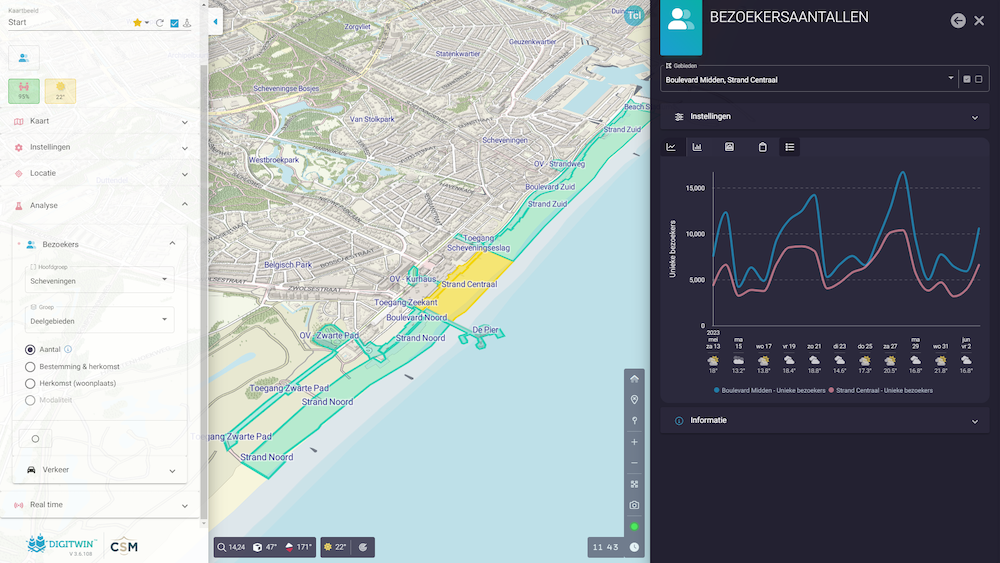
We know more and more about what people do in their free time. Not only through surveys or time-use studies, but also thanks to (public) data on, for example, length of visits and facility use, which is being made increasingly insightful and accessible. Using an online tool or data dashboard such as Digitwin, the next step is to structure data for policy-makers or managers who do not specialise in dealing with this data.
Hugo Braun is a freelance copywriter with a background in leisure, urbanism and (city) marketing.
Big data made clear
Jeroen Steenbakkers, CEO of Argaleo, saw on the one hand an increase in (publicly) available data and an increase in ways to link this information. On the other hand, he noticed that the public space was coming under increased pressure from many and often conflicting interests of users, residents or commercial parties. In addition, it was his experience that the people who have to make decisions about those public spaces did not always have the correct or most complete information available. Digitwin was their way of filling this gap. This tool combines fragmented data about a city or region into a complete and integrated story.
Digitwin combines fragmented data about a city or region into a complete and integrated story.
These data are collected from a variety of sources, some of which are publicly available. These include, for instance, data on traffic volumes, parking garage occupancy and the location of different shops. Data is also purchased, from partners such as Infoplaza for example. A third data source is data from customers themselves. These could be the number of hotel bookings, but also, which is often the case in city centres, crowd shots generated when visitors indicate that location data from their mobile app may be shared.
The smart snapshot
This tool gives policy-makers or managers insight into how visitors use their city centre, natural area or event. As such, it is a digital copy of the public space. This information includes not only ‘hard’ information such as parking spaces, the number of visitors at a given time or the number of vacant properties in a shopping street, but it also provides information about, for example, the weather and its impact on the visitor. This smart snapshot allows non-data professionals to proactively manage events in the public space, develop and evaluate (marketing) policy while making faster and better decisions without the intervention of a consultant’s report. So, Digitwin explicitly does not provide guidance: it presents the data as is.
Mobility, safety and city centre management
The smart snapshot is currently being used particularly in the fields of sustainable mobility, public safety and city centre management. The insights provided by the combined data allow officials, for example, to improve the bicycle accessibility of cities or areas. This would probably concern information regarding travel time, but the safety of various bicycle routes is also considered. For example, are there separate bike lanes or are there dangerous intersections where accidents are more common? But it is also valuable for policy evaluation, answering questions such as "is a high-speed cycling route being used (as intensively) as expected when it was built?”
Crowd imaging and expectation management is a capability often used by event managers and public safety administrators, for example. Data on expected crowds (and especially: expected crowded points), can provide guidance on how to design a city centre or event. On the (busy) day itself, through enforcement and traffic controllers, but also in advance in terms of targeted communication towards potential visitors. Events that took advantage of this include the start of the Vuelta in 2022, King Willem Alexander's visit to Rotterdam on King's Day, or the Carnival or the Jazz Festival in Breda.
Policies can be made to disperse crowds, combat property vacancies or shape location marketing campaigns.
City centre managers also see the data offered as a way to have an ongoing insight into how their city or town centre is performing. This is not limited to information regarding the quantity and type of shops, but it also addresses, for example, the influence of weather on visitor numbers or effects of parking policies. Subsequently, policies can be made to spread crowds, combat property vacancies or shape location marketing campaigns.
Leisure applications
The aforementioned examples are often already leisure-related. A city or shopping centre is just as much a place of economic importance as it is a space for (residential) recreation and tourism. By knowing how an area works and is used by tourists or shoppers, their needs can be better anticipated and the local economy also gets a boost. So, this is a win-win situation. Additionally, safety is a relevant issue at events that take place in (public) space. A concert or amusement park that is perceived as unsafe due to excessive crowds, for example, is logically less likely to result in a positive experience than a similar space where crowds and unsafety are avoided.
Scheveningen: from Living Lab to fully-fledged policy instrument
Argaleo joined the Living Lab Scheveningen three years ago to optimise the technology behind Digitwin from there. There was the opportunity to use traffic cameras, noise measurements and other data about the public space. This was also a testing ground for them to see what was possible with this data, how it could be combined and what the questions and challenges from potential users were. After three years of innovation, Digitwin entered a new phase in the summer of 2022. Meanwhile, from law enforcement and the civil service to the city marketing organisation, insights from the tool are being used. The flow of traffic was regulated so that traffic jams were avoided as much as possible, enforcers were managed more effectively, and marketing campaigns were created to raise awareness of less impactful options for visitors (such as different days or transportation options).
Balancing recreation and nature in the Hollandse Duinen
The Hollandse Duinen (Dutch Dunes), a nature reserve in the province of Zuid-Holland, has to provide space both for nature on the one hand and for day-trippers and recreation on the other. This tension was experienced by its management foundation, which included relevant stakeholders from conservation to tourism organisations to policy-makers at the municipal and provincial levels. It was possible to create effective policies, in which leisure is one of several angles, through the fulfilment of the information needs of this foundation regarding, for example, the flow of visitors. This integration makes it possible to better manage the precarious balance between people and the environment and to guard the natural heritage as well as make it accessible for recreation.
However, the predictive value of data is always as good as the knowledge and experience of the person using it.
Future: from data to experience?
Data can be a beautiful thing, especially for managers in the leisure industry or officials who manage public spaces and who want to be able (or are expected) to make the best short- and long-term decisions. However, the predictive value of data is always as good as the knowledge and experience of the person using it. As a result (and in addition), managing behaviour is often difficult and in public spaces this often needs the coercive hand of an enforcer or the cooperation of the users themselves, as showcased, for example, in demonstrations that have gotten out of hand. In the longer run, the users’ behaviour is even more difficult to interpret, even if all possible historical data is put together. It becomes increasingly challenging when the issue of experience, a topic so central to leisure activities, must also be included in, say, ideas for a future mall or amusement park. Therefore, the next step in the development of Digitwin is to make perception measurable and find ways to influence it, together with leisure managers and officials. How do you ensure that you can offer a combination of activities, through time, optimising user engagement and (tourist) experiences? And therefore, how can you optimise the economic impact of leisure as a result? This is the next step in the development of Big Data in the leisure industry.