The case of the Dancing Cats
Story-based routes as catalysts for meaningful experiences for visitors and local communities

The province of Brabant (the Netherlands) is renowned for its numerous attractions, its picturesque countryside, and its excellent bicycle infrastructure. VisitBrabant Routebureau aims to enhance the province’s recreational offerings through routes based on well-known local stories. Since 2019, the professorship in Storytelling (Breda University of Applied Sciences) and VisitBrabant so far have realised 18 story-based bicycle routes, 12 of which are based on local folk tales. Storytelling is at the core of these routes, because it is a valuable instrument for creating meaningful experiences for visitors. By matching the logic of the storyline with that of the route and the local entrepreneurs, the story-based routes become embedded in the area. When a story derives from the local community, the value of the route stretches beyond the visitor experience. It can reinforce the community’s connection with the story leading to new meaningful experiences. This is the case with the route of The Dancing Cats around the village of Bergeijk.

Moniek Hover is professor of Storytelling, Niels Wittkampf, Juriaan van Waalwijk and Wesley Put are part of the research and development team of the professorship in Storytelling.
The power of storytelling in the physical space
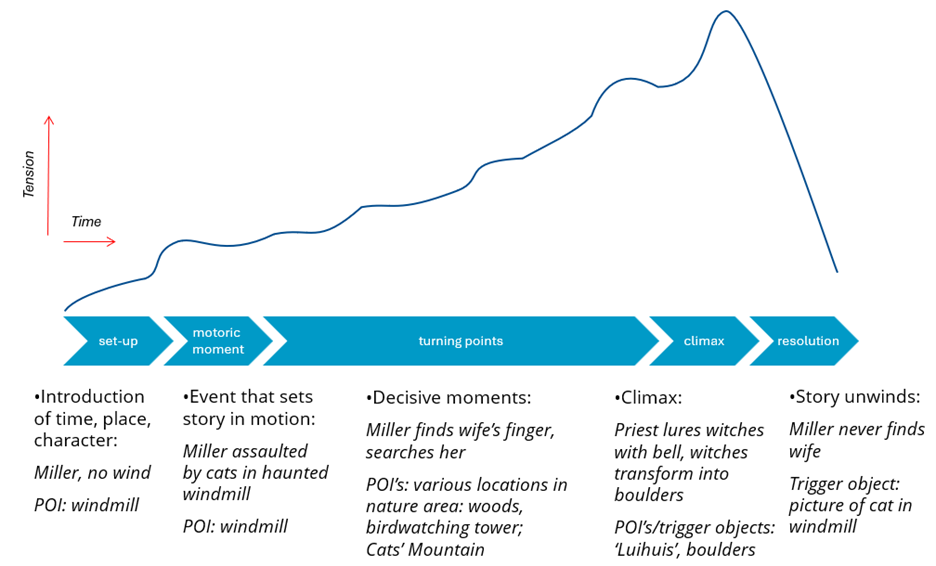
Stories can help visitors attach meaning to places, images or objects. An important objective of stories is to entertain or engage people. Storytelling frequently employs a dramatic arc to build suspense, engaging the audience’s curiosity about the story’s progression. There are various storytelling models for the designing of a dramatic arc, like the five-step model, which consists of the set-up, motoric moment, turning points, climax, and resolution.
Not all storytelling depends on verbal texts. Implicit and environmental storytelling relies on (elements in) the physical environment to convey stories. Experts in folk culture discuss lieux de mémoire, lieux d’imagination, and trigger objects that visitors encounter and that help them experience a story. When a story is set in a physical space, visitors navigate through the story in an embodied way, experiencing the storyline as they move from one location to the next.
Local folk tales as a starting point
The countryside of Brabant looks picturesque, but in the old days it could be scary for the local people. Here, they would encounter strange phenomena for which they imagined supernatural explanations. Boulders from the ice age that they found scattered were thought to be witches turned to stone. A ring of mushrooms became a witches’ circle, where witches or cats - as their alter egos - had danced at night. A pre-historic burial mound was where those dances had taken place. It became nicknamed the Cats’ Mountain. Folk tales about dancing cats emerged here and there. They were cautionary tales. When, as a man, you go out into the night by yourself, beware of dancing cats. They will lure you into their circle and make you dance all night, sometimes until you drop dead.
Storytelling frequently employs a dramatic arc to build suspense, engaging the audience’s curiosity about the story’s progression.
How to create a story-based route
The creation of a route based on folk tales always starts with looking for a specific story (first step). We do desk research of literature on folk culture, but also of documents provided by local experts. An important criterion is whether there is ‘energy’ around a certain story or characters in the local community. In Bergeijk, the Dancing Cats tale is somehow known. It has a theatre called De Kattendans and a windmill which was claimed to be haunted at night.
The second step in creating a story-based route is the exploration of the area by bicycle. Together with a local expert we go in search of points of interest. First of all, we look for lieux de memoire. In this case there was a haunted windmill. Furthermore, we saw the Luihuis, a small building opposite the village church. Its bell is chimed at funerals. We also came across boulders from the ice age as trigger objects. With a rough storyline in mind, we looked for lieux d’imagination. A burial mound in the middle of the woods could well have been a place where cats would dance. From a birdwatching tower, you might see witches flying. During such an exploration, we take many pictures.
A story-based cycling route is not only about experiencing a story. For it to be successful, practical places are included such as parking places, bicycle rentals, restaurants to stop for coffee or lunch, or shops that sell local products or souvenirs.
In the third step we cut out all the pictures and try and match the logic of the storyline with the logic of the route (points of interest, trigger objects) along the five-step model (See Figure 1) we typically use for designing experiences.
The fourth step in the process of developing the story-based route is a workshop with local stakeholders, such as entrepreneurs. We present the storyline with the points of interest and we invite them to come up with additional ideas. In the case of the Dancing Cats, it was suggested that female shopkeepers in the village of Bergeijk could place a broomstick by their doors, symbolising their mode of transportation to work. Another cost-effective idea was to fill flowerpots in front of a restaurant with catnip. Ideally, entrepreneurs during these workshops connect and jointly develop new products, packages, or events.
In the next step, VisitBrabant has mood images and a video trailer made for the route, highlighting meaningful moments in the storyline and certain points of interest. The route is then launched offline and online on all the well-known route platforms. Furthermore, there are social media campaigns and free publicity is generated.
The Dancing Cats
Many years ago, in the village of Bergeijk, there was a prolonged period without wind. The miller Dorus was unable to operate his windmill to grind grain into flour, causing the villagers to go hungry.
The villagers saw that the wind picked up late in the evening, so they forced the miller to work at night. He did so reluctantly because it was well-known that the windmill was haunted then. Indeed as soon as he set to work, he was assaulted by some 40 black cats. Dorus fled.
The miller’s servant was not a coward and offered to do the work. He too was assaulted by the black cats but he fought them off with a sabre.
The next morning, the miller entered the mill and saw something lying on the floor: a cut-off finger, the ring still around it. He immediately recognised his wife’s wedding ring. His wife was missing.
He went looking for his wife in the area around the village: in the woods, in the air. But no sign of her.
There was only one place left to find his beloved wife: the Cats’ Mountain. The miller ventured there at night and found 40 black cats dancing in a circle. Though terrified, the miller joined them, dancing hand in paw. Suddenly, he noticed that the paw he was holding lacked a joint. As he turned to look at the cat, dawn broke. The cats transformed into witches, flying away on broomsticks.
The desperate miller then asked the village priest for help. The priest devised a plan. He rang the bells of the Luihuis to attract the witches, who often flew over the church during funerals. As the witches approached, the priest flung holy water high into the air. Each time a drop landed on a witch’s skirt, she plummeted to the ground and transformed into a boulder.
The miller never found his wife. To honour her memory, he painted a picture of a cat and hung it in the windmill.

Meaningful experiences for the local community
In the case of the Dancing Cats, the launch of the route led to additional spin-off for the local community. VisitBergeijk commissioned a children’s books author to write two books around this story: one picture book to be shown and read out loud at school or at home, and one longer and slightly scarier version for older children to read for themselves. An audio version of the story can be found on YouTube. The idea of the initiator is that the municipality provides a copy of the book as a present for every newborn baby that is registered at the town hall. And that schoolchildren learn the cats’ dance or play in the school musical around this story, possibly in the Kattendans theatre.
The Cats’ Dance is a good example of how story-based routes not only lead to meaningful experiences for visitors, but also serve as practical means to develop networks between entrepreneurs and other local stakeholders, ensuring a flow of additional ideas and resources.
More information
Link to the route: https://www.visitbrabant.com/en/routes-overview/1277629436/the-dancing-cats-of-bergeijk-cycle-route
Link to the trailer: https://youtu.be/umml0Tkg6qk?si=-vP7U2ipvQHJq02K
Dit artikel is eerder verschenen in Uncover, een uitgave van het domein Leisure & Events van de Breda University of Applied Sciences. Nieuwsgierig naar de andere artikelen uit Uncover? Stuur dan een mailtje naar ton@nrit.nl