How to make place in and out of the classroom?
Leisure and placemaking in academic and professional education

It is a term you see pop up in strategic plans, policy documents and in education more and more: placemaking. Will it be the new ‘buzzword’ of the 2020s, or is there more beyond this flashy concept? At the Future of Leisure conference last March, it was one of the central themes, and it already has a prominent place within education. How does the Academy for Leisure & Events make sure that placemaking has a meaningful and practical application within our programmes? This article shows how and why we give placemaking a ‘place’ in our leisure curricula.
Olaf Ernst is coordinator of the Urban Life & Placemaking specialisation at the Academy for Leisure & Events (BUas).
Kristel Zegers coordinates the Leisure and Placemaking course as a lecturer and researcher at the Academy for Leisure & Events (BUas).
From consumption to a human-centred approach
Within the academic Bachelor of Science Leisure Studies, one of the central questions revolves around the context in which leisure practices take place. Physical and virtual places can be seen as contexts for all sorts of leisure practices. At the same time, these leisure practices also influence what places look like or how they are experienced. Leisure thus plays a role in placemaking. To dive deeper into that, the Leisure Studies curriculum offers the Leisure and Placemaking course to second-year students and pre-master’s students.
The course illustrates that leisure consumes place, and that it can be a carrier of spatial quality thus producing place. Since both perspectives are especially prominent within cities, we zoom in on the urban context. The leisure as consumption perspective shows how inner cities turned into theme parks. By making use of cultural flagships to put themselves on the map, cities participated in an intensified rat race for attracting mobile capital of visitors, tourists, businesses, residents -particularly those labelled the ‘creative class’ - to enable economic growth. However, it has become clear that strategies focused on using leisure as spectacle and consumption have downsides: exclusion, homogenisation, privatisation of public space, lack of authenticity to name a few. Not surprisingly, a call for more human-centred urban planning became more prominent. Emphasis is given to quality of life, sustainability, inclusion, collaboration, and community, thus placing social objectives next to economic gain. These thoughts steer leisure away from primarily commercial connotations towards thinking of leisure as focal practices. Leisure can unite people around a shared interest (a focal activity), which stimulates social interaction, and thus supports the creation of trust. In this way, leisure creates opportunities for strengthening social cohesion among and between communities of shared interest.
Field trip, game, and project
Placemaking is a collaborative effort, ideally community-focused, often combining both top-down as well as bottom-up strategies. Within education we believe that placemaking not only needs to be studied but also experienced. We therefore incorporated a field trip, a serious game, and a practical assignment in the Leisure and Placemaking course.
We are the connectors. We join forces to create cool places making urban life better and more fun.
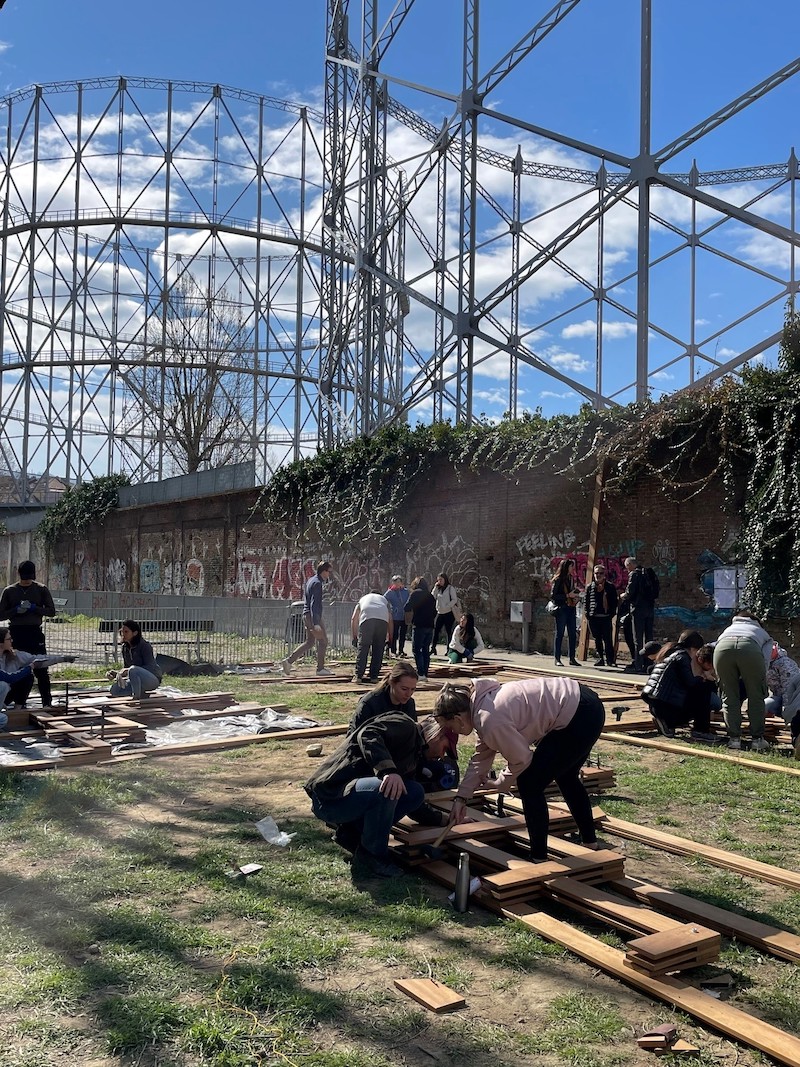
The field trip to the Galvanitas factory in Oosterhout taught students how complex placemaking processes are, given the variety of interests of different stakeholders, and how challenging it is to balance hardware, software, and orgware.
To further understand the different stakeholder perspectives students played a serious game. This multiplayer physical board game in combination with a digital dashboard was, according to researcher and game facilitator Jessika Weber, originally developed to "promote stakeholder engagement, deepen the understanding about the complexity of sustainable urban tourism and explore integrated strategies to manage sustainable tourism.” Students participated in five stakeholder teams representing destination management, hospitality, attractions, mobility, and ecology. Actions that students took on the game board (e.g. building a public transport stop, removing or building a hotel, launching a marketing campaign) were translated to the dashboard showing the effects of their actions in terms of ecology, visitability, liveability, equity, economic growth and smart citizenship. Students reflected that "Since residents and visitors did not have a voice, our team forgot to consider their wishes in the first round”. Students became aware of politics, power relations, and - most importantly - the need to have a shared vision.
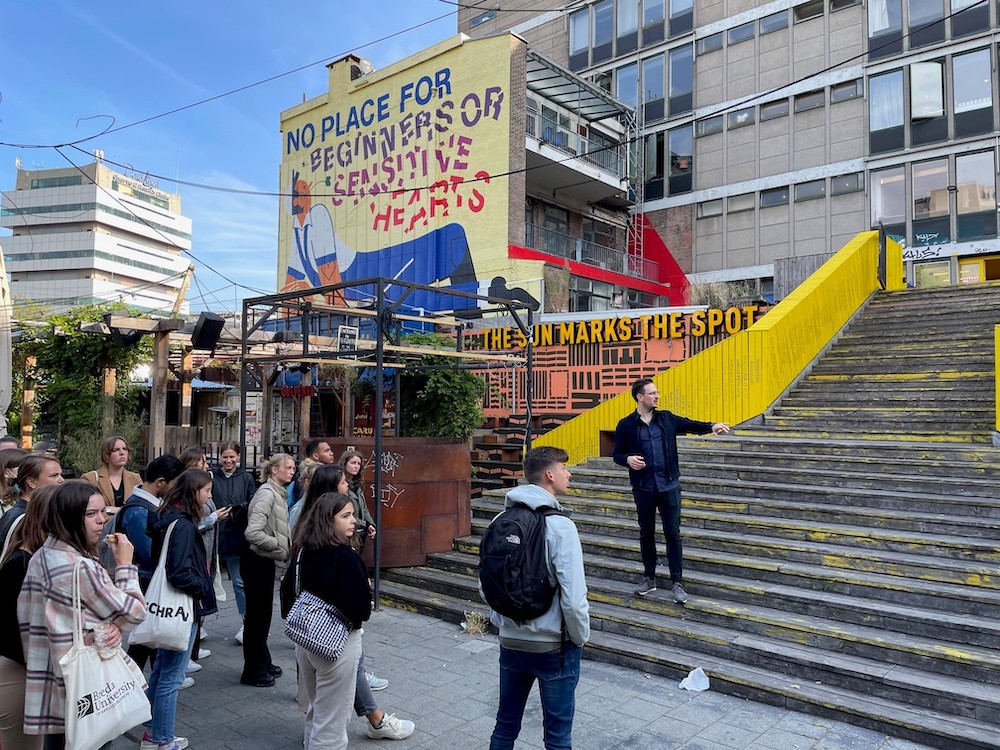
In their practical assignment students also experienced the diversity and complexity of stakeholder processes within several (creative) placemaking projects. Business cases were Galvanitas, Breda Botanique, Pier 15, MotMotGallery, and Tramkade. Their educational vlogs showed suggestions for strategic interventions to enhance placemaking processes. This can provide food for thought to professional bachelor’s students to concretely execute them.
Placemaking linchpins
Placemaking manifests itself prominently in urban environments. After all, many spatial challenges occur in complex contexts with a diversity of people living, working, and spending their free time. Therefore, in September 2021 a track within the bachelor’s programme in Leisure & Events started, named Urban Life & Placemaking. In this programme we immerse students in all kinds of aspects of leisure in city environments, with a prominent position for placemaking. In a two-year curriculum, starting after the propaedeutic year, students learn how to bring the vision of our specialisation into practice: "We are the connectors. We join forces to create cool places making urban life better and more fun”. As you can see from this vision, communication, cooperation, concepting and citizen’s well-being remain central.
What the track aims to do is find a balance between the social, economic, and spatial aspects of urban leisure and specifically placemaking. Students will not become experts in either social issues, commercial area development or urban planning and design, but will be the ones who bring these different views together. In this way, they become central points of contact for all kinds of stakeholders in the city.
Students became aware of politics, power relations, and - most importantly - the need to have a shared vision.
Because Urban Life & Placemaking has a broad view on leisure in cities, many different themes are offered to students as topics of study: from greening aspects such as the use and value of city parks to the issue of gentrification and the effects on leisure supply, social cohesion, or property prices. Inclusion is another big theme, in the broadest sense of the word and aimed at all citizen groups. The role of arts and culture in area development is a topic which logically fits within our educational programme. At the same time, other leisure subsectors such as events, hospitality, and sports also get attention. These topics are mainly taught in ten-week courses, but also by four weekly visits to Dutch cities, where students take a deep dive into a specific topic. This programme element is called Urban Scope and lets students experience the practical translation of broad themes such as mobility, storytelling, and hospitality & food.
To bring theory into practice, students work on projects for a substantial number of study credits. The programme is flexible meaning students can decide themselves on which competencies and learning outcomes they want to work, in which time frame and with which fellow student(s). This gives them a lot of freedom throughout the year. It requires self-organisation, discipline, and proactivity. Some assignments are offered by the specialisation itself; some are recruited by students. Examples of projects are the organisation of a carnival event aimed at international students in Breda, and a new concept for an event in Rotterdam where artists open their studio doors to their audience.
To get the placemaking aspect even more across, third-year students move to a European city for a five-month time frame, in a group of three to five students. Here, they transform from being tourists at the start to becoming ‘locals’. They do this by living, working, and enjoying their leisure time in cities such as Porto, Turin, and Bilbao. By means of online education and assignments they are supported by city coaches. At the same time, students work on their professional development by doing volunteer work or a work placement at a leisure-related organisation. They also get to know their city better by ‘challenges’ in which students need to conduct assignments often together with locals.
Best of both worlds
In describing the two courses we offer our students we illustrated the importance of leisure in placemaking. As a context to bring people together, but also as an instrument to enhance placemaking. We believe it deserves a prominent place within our curriculum, in a way that goes deeper than using it as a marketing tool. Since we offer a programme on both academic and professional bachelor’s level, we also have the possibility to learn from each other and use the best of both worlds in terms of course and class design.