Organising intercultural encounters in the city
Learning, exploring and making theatre with residents

This Uncover provides the opportunity to explore the theme of internationalisation@home in many directions. The theme refers to the potential for experiencing cultural diversity at university and looking for a shared basis for living together. More than on the university campus where (English) linguistic, technological, mental and physical literacies are shared, this diversity resonates throughout the city. In this article, we highlight two approaches that offer insights into the opportunities and challenges of harnessing super-diverse intercultural encounters in the city. We do this based on the learning experiences of Breda University of Applied Sciences (BUas) through Samenwerkplaats (SWP) in Urban Living Lab Breda (ULLB), and also through Stormkamer, the Breda theatre company, which uses its methodology to discuss the plurality of voices and perspectives. Both work in the Hoge Vucht neighbourhood in Breda, a district of about 20,000 residents. Both BUas and Stormkamer believe that the connection to the neighbourhood should have transformative value to residents.
Ger Pepels is a lecturer and researcher at BUas and he is a driver of ULLB’s Samenwerkplaats.
Kim Zonderveld works at Stormkamer as an urban dramaturge, theatre teacher and co-director.
Experiencing the super-diverse city
What is needed to make the value of diversity in the city fruitful for all involved? Can cross-cultural encounters be of such value that they "positively transform the people directly involved, the communities they are part of, and the structures shaping their lives” (Transformative research, Othering & Belonging Institute, Berkeley, 2024)?
In the immediate living environment of residents, there are sometimes challenging issues in terms of liveability and livelihood. A report by the Breda Rekenkamer (Breda Audit Office) (2021) points to the growing gap in the development of the city's neighbourhoods. This was partly the reason for launching the ‘Improve Breda’ programme. Where organisations recognise issues, they develop policies and take action. Think of services for children, adolescents, the unemployed, people with limited financial possibilities, women with a migration background, the elderly, and so on. The services are often standardised yet individually oriented, depending on policy priorities.
Both BUas and Stormkamer believe that the connection to the neighbourhood should have transformative value to residents.
The question is whether such an approach based on specific issues is sufficient. Residents often experience the situation completely differently. They certainly feel and recognise challenges. However, the approach does not take into account the plurality of the situation in which the residents find themselves. Residents often do not fail to mention that they enjoy living in the neighbourhood, value diversity as a rich resource for their lives, and want to contribute to society.
The issues vary from person to person because, after all, people's situations vary greatly. For instance, people of more than 60 nationalities live in Hoge Vucht who, moreover, differ in terms of socio-economic position, social network, level of education, gender, age, ethnicity, family composition, language skills, and living situation. In other words, the diversity is enormous, as are the chances of intercultural encounters.
Moreover, other residents may feel excluded (‘othered’) by this approach designed and taken by institutional players. They feel alienated within their own uniquely multifaceted environment and lifeworld. They are not among the policy's target groups. The older, original Dutch residents of the neighbourhood see many target-group-specific initiatives, while the growing loneliness within their own group receives little attention. They retreat into the private domain and avoid public spaces.
When employees of the municipality and civil society organisations get involved, they do immediately ask about the motivation for this involvement. "If we want to improve the neighbourhood, what would be the best way to do that? And who decides that?” says Aïssa, a young person from the neighbourhood. The great diversity also makes it challenging for residents to develop a unified voice. "With people who have such different backgrounds, uniting is very difficult. Actually, the neighbourhood is too diverse. And yet you have a common interest. But it is difficult to fight for it together. This is also because a lot of suffering is actually personal. It's not like that saying: a sorrow shared is a sorrow halved. That's just not true,” as Kiki, an active neighbourhood resident from Hoge Vucht, points out.
For the voice of the residents themselves to be heard, it is essential to provide both time and physical meeting places (such as community centres, libraries, public areas) where meaningful involvement can take shape. Based on the ideas of Asset-Based Community Development, SWP aims to anticipate by responding to requests and questions and, above all, to the strengths of residents. It is here that through education and research, the voice and strength of that great diversity of residents can be connected to issues that affect the living environment of residents. It is in these encounters that you feel the challenge to help interconnect the diverse cultural realities of residents. The legitimate question is to what extent SWP has succeeded in this.
Between wealth and want
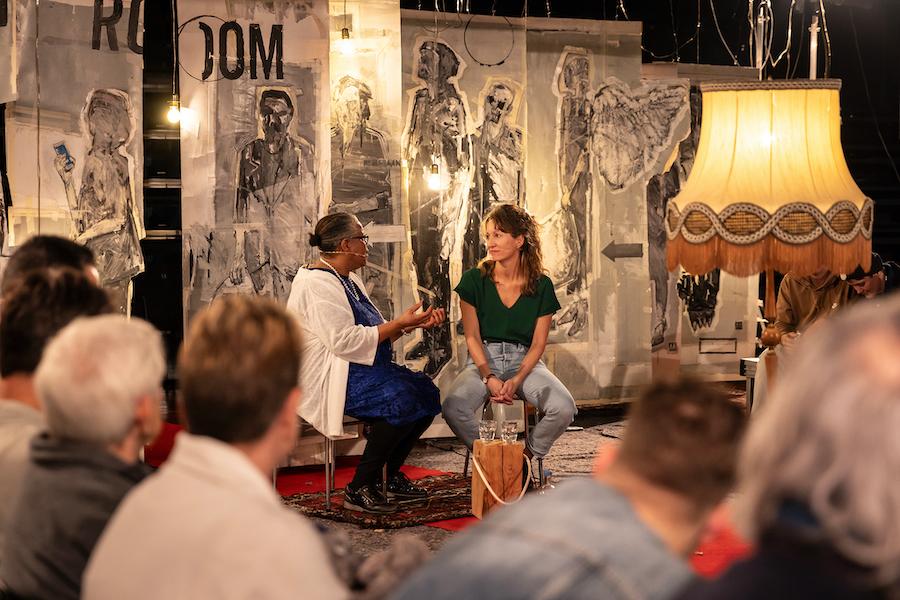
The theatre company Stormkamer set to work on the themes of (in)security of existence and inequality in 2023. How do you deal with people who have more or less than you? With this question in mind, they had numerous conversations. The question does not only refer to having many or limited financial resources, but also to opportunities, trust or a network. In five neighbourhoods of different cities, Stormkamer explored, together with residents and professionals, the different visions and experiences surrounding this theme. In Breda, they delved into Hoge Vucht.
The great diversity poses a challenge for residents in terms of developing a unified voice.
Stormkamer believes it is important that their performances are rooted in a city, and that all perspectives are part of it. While theatre is sometimes seen as something for a small group of people, Stormkamer resists that. Stormkamer, frankly, had not been in Hoge Vucht much, prior to this project. Hanna van Mourik Broekman, Stormkamer's artistic director, went out and about, strolling along streets, stepping into community centres, going to coffee hours, flat meetings, and bringing breakfasts around. Although she was often warmly welcomed, it was also with caution: "When I saw you walking through the neighbourhood, I thought, ‘There's another one of those stuck-up, high-class women with a questionnaire. Here for just a quick moment, gone even quicker’”, Raymond, a neighbourhood resident of Hoge Vucht, related.
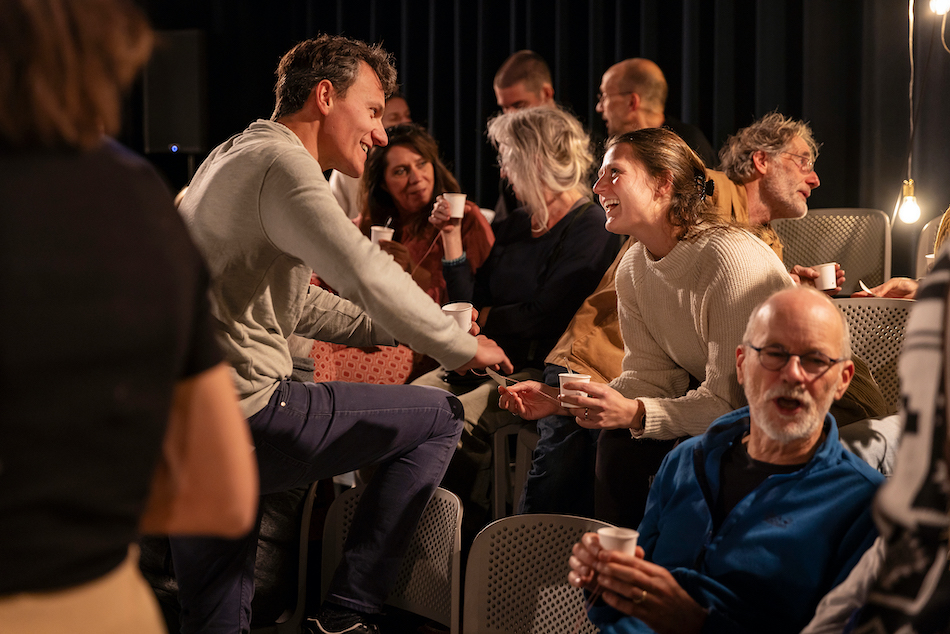
Still, the theatre company managed to meet the neighbourhood residents. The entire Stormkamer team resided in the neighbourhood, and conversations with residents became scenes in the performance. Residents were invited to share their own stories. They succeeded in organising two valuable interactive evenings where various parties from the city came together - residents from Hoge Vucht, organisations, but also the municipal executive councillor and other professionals - to talk about insecurity of existence and inequality of opportunity. Two evenings where the strength of the neighbourhood was showcased, laughter was shared, but problems were not avoided either.
The continuation
Both ULLB and Stormkamer are committed to finding new ways to connect with the culturally diverse voices of residents. Also, both aim to achieve transformation, adding to strengths and addressing challenges in a way that aligns with all involved. If transformation can occur at individual, interpersonal or group, institutional or systemic levels, then to date, only a few individual or small groups of residents have been affected; at the other levels (institutional or systemic) the results have been limited. Residents appreciate the initiatives, but more is needed to achieve transformation.
Real commitment and equality are essential in this respect. Really doing things together requires a certain degree of discomfort. By genuinely looking, seeing and being there. Not just for a while. Stormkamer and ULLB have made a start, but now it is important to continue. It is about valuing each other's knowledge, skills, experience and interests. In this process, equality is crucial. It is important, including for our education, to recognise that professionals (or professionals-to-be) need the ability to ‘bridge’, to ‘come together across acknowledged lines of difference in a way that both affirms their distinct identities, and allows for a new, more expansive identity’. What’s more, you need to recognise that you don't know everything, nor do you possess the absolute truth. Instead, you have to find out collaboratively what is needed.
More information
- https://obiu.org/course/fundamentals-of-bridging
- stormkamer.nl
- urbanlivinglabbreda.nl