Key aspects to ignite organisational change
From Complexity to Co-creation

Afbeelding van Stain_Marylight via Pixabay
In this article we provide you three key aspects how to enable change in your organisation or project team. We based this on the Imagineering paper by Engels (2019) who works with an international, multidisciplinary project team that temporarily exists to develop the fourth terminal for Schiphol. At the heart is the joint venture of four different companies: a Dutch and a Spanish architectural organisation, and a Dutch and a Spanish engineering organisation.Moreover, various international subcontractors (like process and finance managers) are involved as well. The more than 300 project members, representing over 15 different countries, working for different companies specialized in very diverse disciplines make the characteristics of this temporarily project team highly complex. The dynamics of such a project team should lead to collaboration and co-creation. However, the issue at the start of the research was the lack of it. Project members stayed on their own company islands. Through her Imagineering project Engels (who is part of this temporary project team as an independent office manager) identified three key aspects in igniting co-creation. In this article we will provide insight in these key elements. Moreover, based on Engels’ work, we provide you with a Roadmap that can be useful in facilitating your own organisational change process.
1. Create awareness through experience
COVID-19 makes it apparent that we live in a VUCA world: a world that is volatile, uncertain, complex and ambiguous. While COVID-19 is creeping closer towards its prey and disrupts our way of living, companies, projects and teams need to think creatively on how to cope with this creature. But why are we now willing to make these changes, when the past was not as manoeuvrable? Because people have to experience the need for change before they act on it.
Hence, also in none COVID-19 times, having people experience the need for change is key. As Engels vividly demonstrated, just telling people does not have any impact. Even though managers in this project had made several attempts to explain the importance of collaboration and co-creation, project members would go back to their usual routines. However, once Engels had project members actually ‘experiencing’ the complex reality through a game she designed, the realization and awareness of what the managers meant, was achieved. Members experienced a culture shock in which they realised that different cultures perceive things differently and play by different rules.
The game raised awareness that project members from different companies/cultures need to try and adopt a new set of rules. This is well illustrated with the following quote of one of the project members: "This game has created awareness of the fact that there are different companies and thus different people working in this project. It is nice to notice that most of the people had a moment of realization at the end of the game that there is more to this project, it opens up’’. All in all, the game served as a true eye-opener. By creating awareness through experience, participants were involved in the current situation and became committed to the process of change.
2. Design an open environment using creative elements
But why is it so important to get your employees or team members committed and engaged? Well, teams exist of multiple people: a variation of expertise, company cultures, nationalities, values but above all, different interests. Synergizing these perspectives results in a powerful source. New ideas emerge when different perspectives collide.
However, assuming an involved and committed team is not self-evident to happen and can be considered complex in times of change. Moreover, bridging these differences is more easily said than done. In this Imagineering research it turned out that one of the biggest pitfalls was that project members highly relied on assumptions they have about each other. For instance, team members from one company noticed other team members from another company strictly worked from 09:00h – 17:00h. This observation impacted the way they perceived these project members in a negative way. In order to reduce these biases, Engels facilitated ‘an inclusive and open environment through the use of creative elements’. Once the project members were invited to draw their assumptions, they realised there is more to it than meet the eye. It turned out that the strict working hours had nothing to do with the people, but the company policy protects their employees not to work overtime. Hence this exercise did not only ignited a lot of laughter, project members acknowledged that appearances can be deceptive. It made them aware to blur their own company boundaries and started to co-create. This is well illustrated by a quote of one of Engels’ participants: "This intervention made us realise that it is not obvious to integrate with something you are not familiar with (..) [It] not only opens up and creates a transparent working environment, we now realise how important the process of integrating teams is for the efficiency and outcome of the project’’.
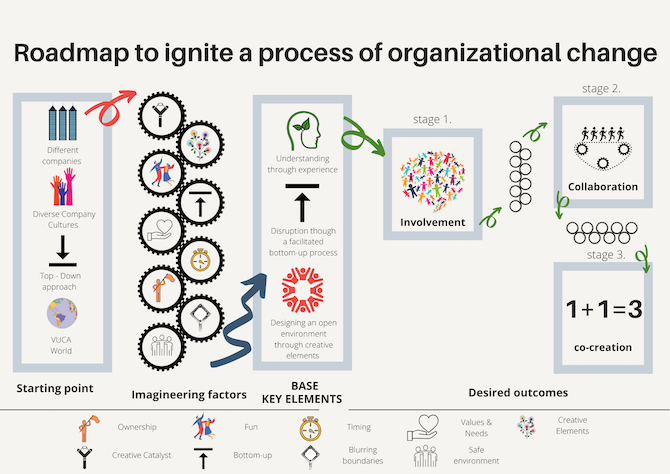
Thus, creating mutual understanding ignites a collective process towards change. This can only be reached by facilitating an open and inclusive environment with the use of creative elements. I hear you think, facilitation, right… how exactly? Engels developed a Roadmap to ignite organizational change that shows the key elements to use. However, the challenge for you as a facilitator is to find out in what way your team engages. So, to facilitate a process in which a common understanding and co-created solution is reached. Hence, a bottom-up approach invites, engages and secures a sustainable change because people are part of the process.
3. Disrupt through a facilitated bottom up process
Lastly, Engels showed the importance of being disruptive. To design and facilitate a disruptive process, a co-creative catalyst is needed; a person who creates conditions to engage people. Moreover, this co-creative catalyst should take a human-centred approach and act as a servant leader. Engels took this role as well, as this is preferably someone who is an insider, but at the same time has an independent perspective. Through her interventions she made all project members fully aware of the current situation and created a commitment to change. Hence, the current status quo of this project was disrupted.
To conclude, when the need for organizational change is initially not fully recognized by people, Engels showed that when the need is experienced in a transparent and fun way, people get involved and become committed. However this process needs to be carefully designed and facilitated by a co-creative catalyst. Without such a facilitator it is difficult to have an inclusive environment emerge. Moreover, make use of the key aspects in the Roadmap (see illustration). In case you are not able to identify a suitable person within your organization to take on this role, it is always possible contact one of the many Master Imagineering alumni or check out the website ‘synergy’ (read the abbreviation out loud): www.cnrg.nl
References:
Engels, E. C. (2019). Synergy is the creation of a whole that is greater than the simple sum of its parts. Research for key elements on how to create synergy in an emerging temporary project team (unpublished master Imagineering thesis). Breda University of Applied Sciences, the Netherlands.
Dit artikel is eerder verschenen in Uncover, een uitgave van het domein Leisure & Events van de Breda University of Applied Sciences. Nieuwsgierig naar de andere artikelen uit Uncover? Stuur dan een mailtje naar ton@nrit.nl.
Trefwoorden: ondernemen, organisaties