Walls that Speak
The meanings stakeholders attach to public art and how these relate to policy claims on its effect
Inhoud van dit artikel
Abstract
Public art is frequently presented in policy as a universally beneficial intervention, with claims on its effects appearing across four coalitions: physical-aesthetic, economic, social, and cultural-symbolic (Zebracki et al., 2010). Yet how stakeholders actually perceive and attach meaning to public art remains largely underexamined. This study examines what meanings stakeholders attach to a public art intervention and how these relate to policy claims on its effect, using the Mi Lobi Zuid mural in Rotterdam South as a case study. An exploratory qualitative strategy was adopted, combining 31 semi-structured interviews with analysis of two Rotterdam policy documents.
The findings show that stakeholder meanings and policy claims broadly align, but perspectives on effects are more nuanced than policy implies. The relationship between stakeholder meanings and policy claims is strongest on the physical-aesthetic level, though whether the mural brightens the environment depends heavily on its surroundings. Economic claims on visitor attraction are perceived to materialise only when artwork is deliberately designed as an attraction or linked to a broader experience. Claims on intangible effects, such as social cohesion and cultural identity, showed a more modest relationship, as these tended to be either difficult to link directly to the artwork or strongly actor dependent. An unexpected finding was that the mural triggered spatial reimagining, suggesting that public art's transformative potential may lie more in shifting perception than in producing direct measurable effects. Overall, the findings suggest that attaching meaning to public art is fundamentally context dependent, pointing to the need for more context sensitive claims in public art policy.
Keywords:
- public art
- murals
- meaning-making
- policy claims
- stakeholders
- urban regeneration
Introduction
After deindustrialisation in the 1980s, public art increasingly came to be seen as a popular tool for cities to redefine themselves economically and symbolically (Hall & Robertson, 2001; Zebracki & De Bekker, 2018; Cheung et al., 2021). The city of Rotterdam is an example of this process. According to the bureau Beeldende Kunst & Openbare Ruimte Rotterdam, there is no city in the Netherlands with as much visual art in public space as Rotterdam (BKOR, n.d.), and this belief is reflected in Rotterdam's policy documents. Academic literature similarly frames public art as contributing to aesthetic quality, supporting regeneration and tourism, and fostering social cohesion and cultural identity.
Yet Hall and Robertson (2001) and Zebracki et al. (2010) argue that claims made about public art in policy and academic literature are often romanticized and lack empirical grounding, a critique they conceptualise as 'public artopia'. Policy narratives often present these claims as self-evident (Crehan, 2011, as cited in Zebracki & De Bekker, 2018), while little attention is given to public art perception and engagement from the perspective of the publics (Zebracki, 2012). This raises the question of whether dominant policy claims relate to the perspectives of those who actually encounter public art in everyday life.
The aim of this exploratory research is therefore to offer a more comprehensive understanding of the meaning-making of public art by stakeholders and how these meanings relate to policy claims on its effect. The central research question is:
Research question What meanings do stakeholders attach to a public artwork in practice and how do these meanings relate to policy claims on public art's effect?
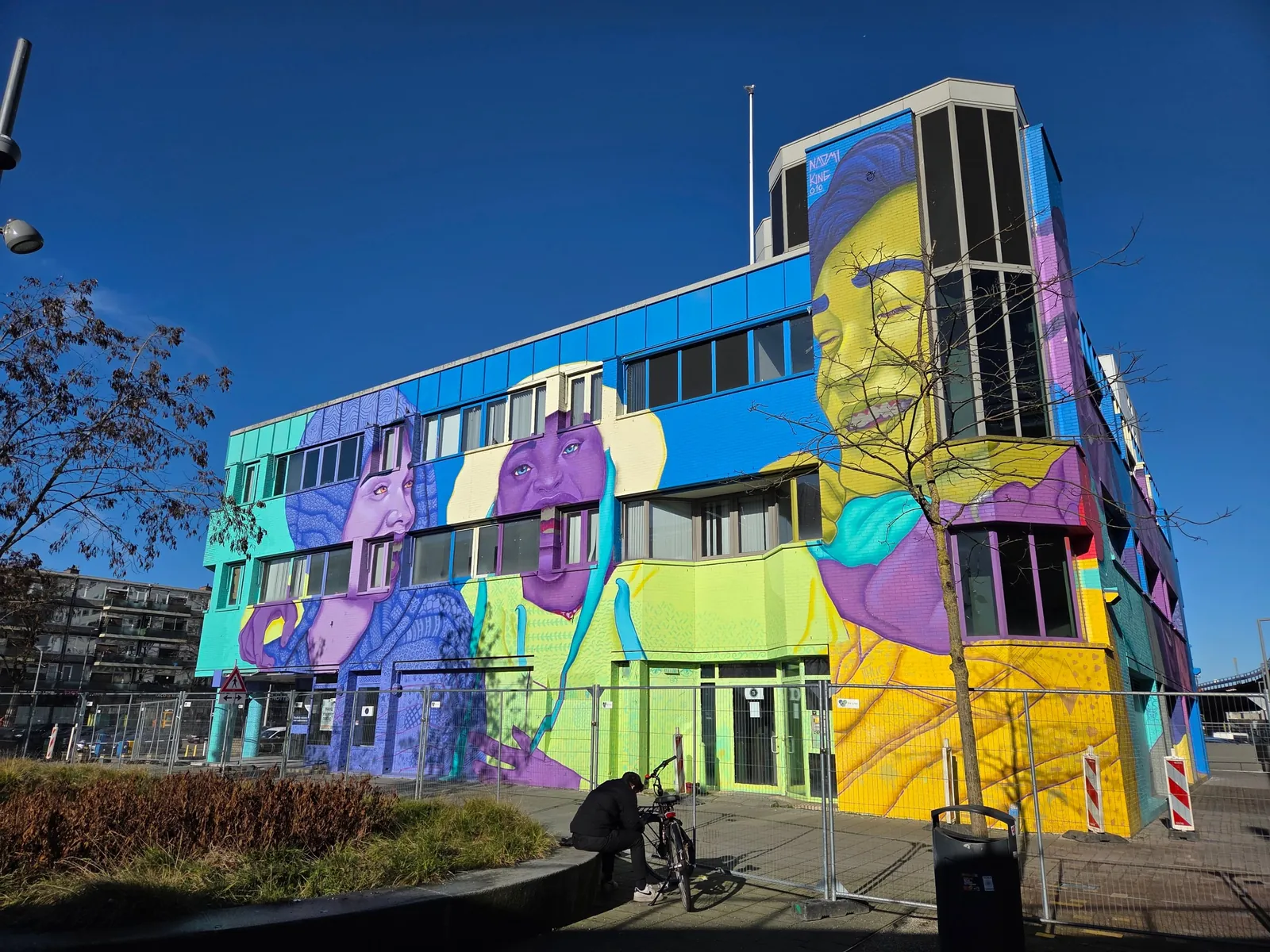
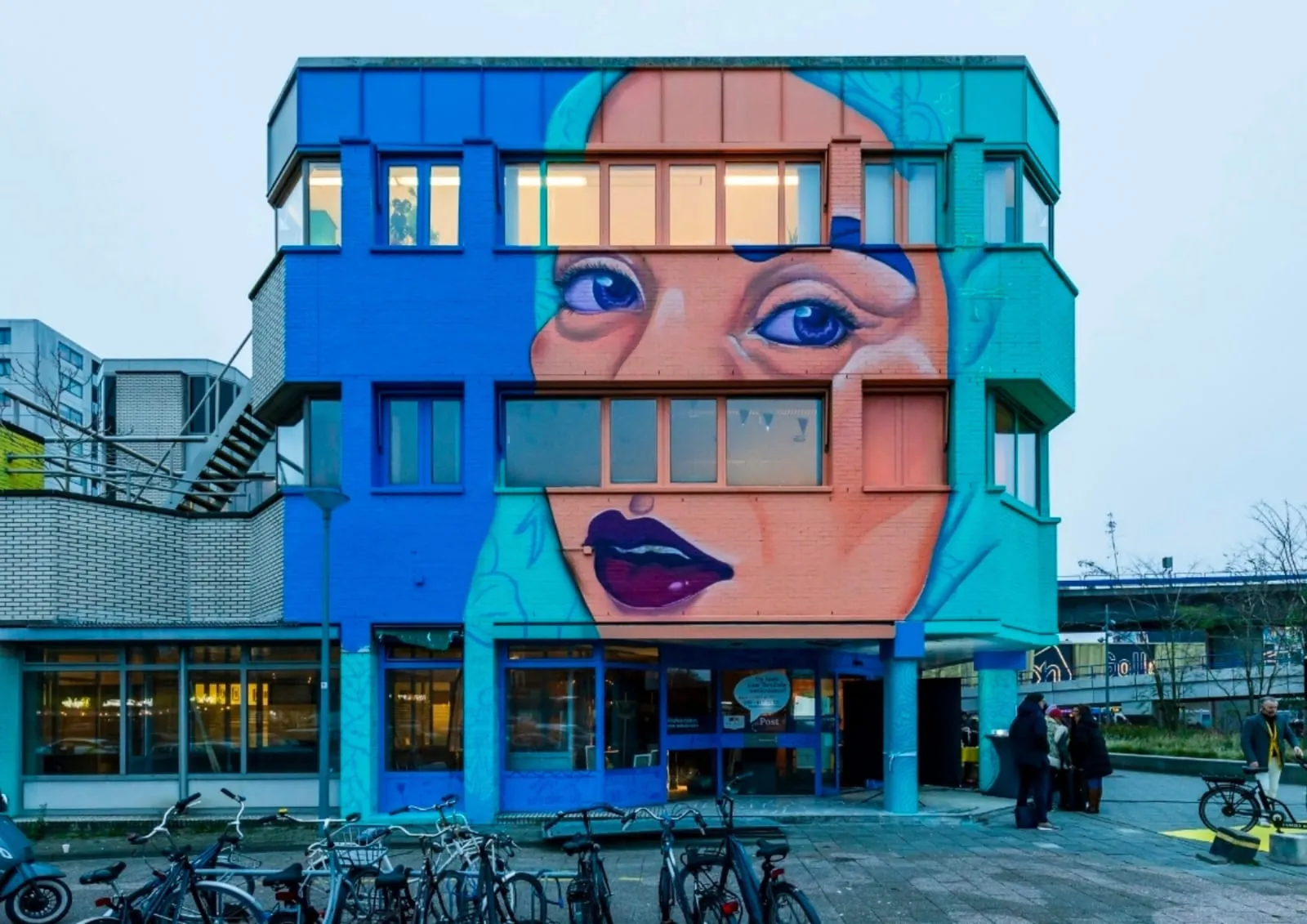
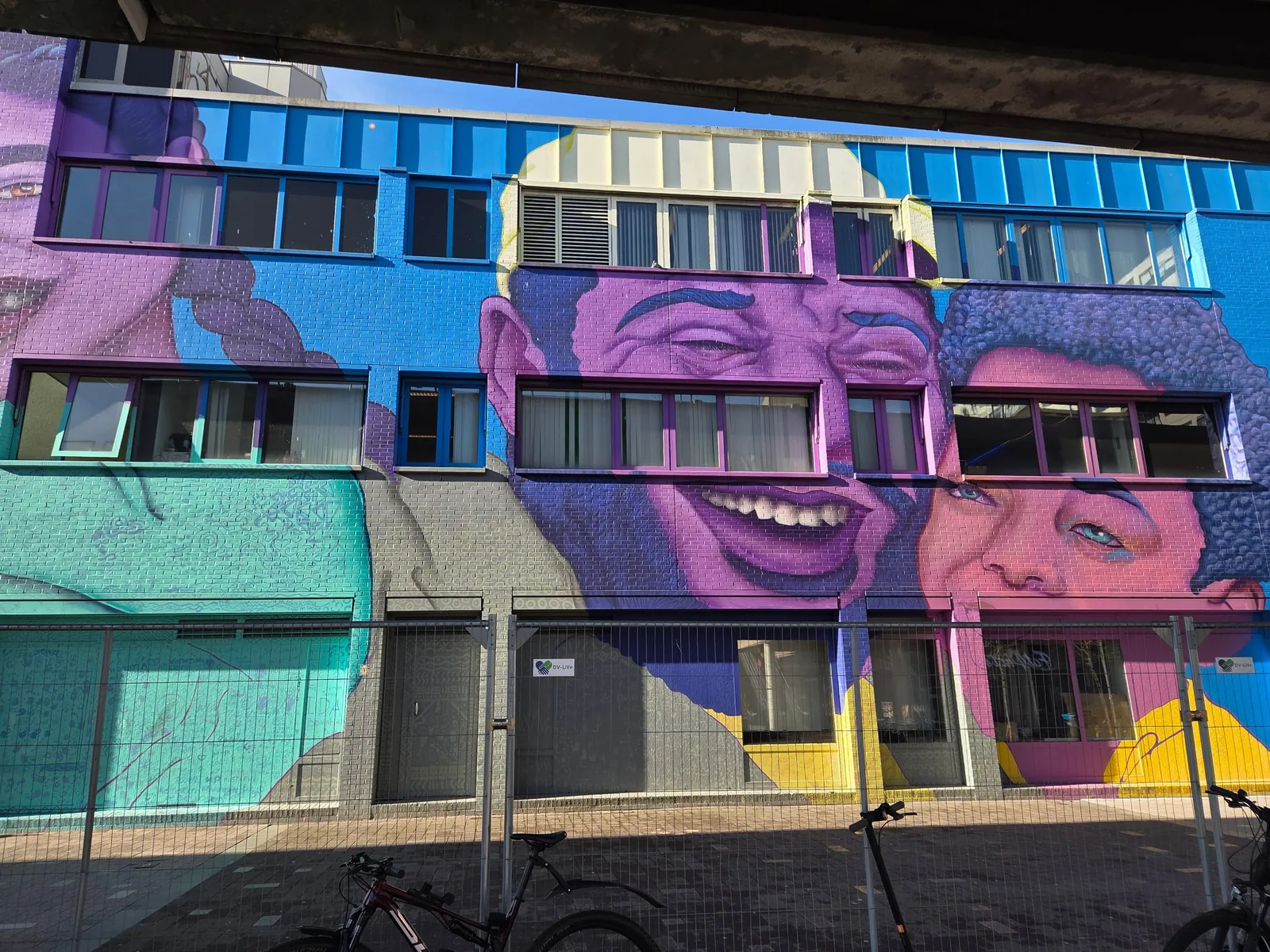
To answer this, a case study was conducted on the Mi Lobi Zuid mural at Zuidplein in Rotterdam South, realised in 2024 as a participatory initiative led by artist Naomi King in collaboration with the Urban Leisure and Tourism Living Lab (ULTLAB) and property owner Heijmans. Around 400 residents contributed to painting the final artwork. The mural is titled Mi Lobi Zuid, meaning 'I love South' in Surinamese, and is situated on three sides of an anti-squatting building on a busy urban square surrounded by a metro station, theatre, library, shopping centre, and residential buildings.
Literature Review
Claims on public art's impact
Public art is understood as a broad umbrella term for publicly funded works of art in freely accessible locations that serve community interest (Lacy, 1995; Miles, 1997; Cartiere & Willis, 2008). Zebracki et al. (2010) identify four claim coalitions commonly made in policy and academic literature. Physical-aesthetic claims argue that public art enhances the aesthetic quality and attractiveness of a place, encouraging more intensive use of public space. Economic claims frame public art as a driver of economic development, linking cultural interventions to place promotion and cultural tourism. Social claims position public art as addressing community needs, reducing social exclusion, and fostering connections between groups. Cultural-symbolic claims emphasise public art's role in enhancing awareness of local history and identity, contributing to local distinctiveness. Zebracki et al. (2010) note that these claims are reciprocally connected and often lack empirical evidence to support them as actual outcomes in practice.
Meaning-making in public art
Meaning is not inherent to the artwork itself, but is shaped through situated interactions between actors, place, and time (Zebracki et al., 2010; Mezzadri, 2021; Cywiński & Karyń, 2024). The actor dimension emphasises that meaning is never neutral: artists, policymakers, institutions, and residents each understand and position public art through their own roles and experiences (Zebracki, 2014). The place dimension recognises that how public art is understood cannot be separated from the space in which it is situated, as neither the artwork nor its spatial context is free from meaning and associations (Cartiere & Zebracki, 2016; Kwon, 2004). The time dimension acknowledges that meanings change over time and are shaped by when the artwork is encountered, whether during the planning, implementation, or post-installation phase (Foreman-Wernet & Dervin, 2017; Cartiere & Zebracki, 2016). These three elements are closely interconnected rather than separate, forming the analytical framework for this study.
Methodology
This study adopts an exploratory qualitative research strategy, as meaning-making is personal and context dependent, making an open and flexible research design more appropriate than a hypothesis-driven one (Jones, 1995). A case study approach is used, focusing on the Mi Lobi Zuid mural in Rotterdam South.
The research follows a two-step approach. First, two Rotterdam policy documents were analysed using purposive sampling to identify claims about public art: the Initiatiefnota 'Ruimte voor Street Art' (Verveen et al., 2017) and the Visie Cultuur op Zuid 2020-2030 (Gemeente Rotterdam, 2021). Claims were extracted and categorised according to Zebracki et al.'s (2010) four coalitions. Second, 31 semi-structured interviews were conducted with 35 stakeholders of Zuidplein, including residents, visitors, employees of nearby businesses, the artist, initiators, and collaborators. Of these, 24 interviews were conducted on the square using convenience sampling, and seven were planned in advance through the ULTLAB network. Interviews were structured around the four claim coalitions as guiding themes, using follow-up questions to explore underlying motivations that could be linked to actor, space and/or time specifically.
Interview data was analysed through thematic coding using a visual overview in which responses were colour-coded per coalition. Following this, the context of interpretations was examined through the analytical lens of actor, place, and time to understand the underlying factors shaping their meaning. All interviews were recorded with explicit consent and anonymised in the analysis. The researcher acknowledges that the depth of interviews varied depending on respondents' interest in art, which may have introduced some bias towards more reflective respondents.
Results
Rotterdam policy documents
The Initiatiefnota 'Ruimte voor Street Art' (Verveen et al., 2017) touches on all four claim coalitions, placing the strongest emphasis on the physical-aesthetic and economic. It frames street art as brightening neighbourhoods and making the city more attractive, while also arguing that it attracts visitors and positions Rotterdam as a creative city. Social claims are addressed modestly, focusing on the feeling of safety rather than community cohesion or social interaction between groups. Cultural-symbolic claims relate to strengthening neighbourhood DNA and local distinctiveness, though the document simultaneously acknowledges Rotterdam has not yet learned to strategically use street art to represent neighbourhood identity. The Visie Cultuur op Zuid 2020-2030 (Gemeente Rotterdam, 2021) is more limited in scope, addressing only physical-aesthetic and social claims, using cautious wording such as 'appears to' to describe the effects of street art on the experience of the environment and the feeling of safety among residents. Both documents present their claims without empirical substantiation.
Physical-aesthetic meanings
Regardless of personal interest in art, respondents generally experienced the Mi Lobi Zuid mural as a visual addition to the square. With Zuidplein undergoing redevelopment and much of its surrounding environment consisting of grey concrete structures, respondents frequently described the mural as bringing colour and liveliness to an otherwise monotonous environment. One employee described it as 'a nice pop of colour within a grey and beige environment.' The mural was experienced as a landmark by some, with one respondent noting it now functions as a directional reference point when giving visitors directions to her restaurant. At the same time, opinions on the colour palette including purple, green, blue and yellow were mixed: some experienced the colours as warm and inviting, while others associated particular tones with coldness or distance. The findings suggest that the appreciation of the mural as a visual improvement is inseparable from the character of its surroundings and the personal associations that were made with the colours, making the aesthetic meaning strongly actor and place dependent.
Economic meanings
Neither residents, visitors, nor employees experienced any noticeable change in the types of visitors the square attracts since the mural's installation. Respondents noted that the participatory creation period generated significant activity, with around 400 participants from Rotterdam South and beyond, but that everyday dynamics largely returned to normal once the mural was completed. Six respondents spontaneously compared Mi Lobi Zuid to a nearby mural of Jeangu Macrooy on the shopping centre wall, which they perceived as attracting more public attention due to its realism and its connection to the Eurovision Song Contest hosted in Rotterdam in 2021. This suggests that recognisable imagery and ties to memorable local events may shape whether a mural draws public attention. Respondents who attached a promotional meaning to Mi Lobi Zuid perceived it as part of a broader process of growing attention towards Rotterdam South. This meaning is both time- and place-specific: it is rooted in the ongoing redevelopment of the area and only makes sense against the backdrop of Rotterdam South's perceived history of being overlooked. An unexpected finding was that the mural triggered spatial reimagining. The artwork appeared to breathe new life into the anti-squatting building, prompting multiple respondents to spontaneously imagine alternative uses for it, such as a community centre or youth space. These ideas were rooted in their knowledge of the area and what the neighbourhood needs, making this finding once again place-specific.
Social meanings
Respondents generally found it difficult to identify a direct link between the mural and social interaction in the neighbourhood. One employee from the community centre noted that 'residents of South are pretty social by themselves, so the mural did not have influence on that.' For those involved in the participatory painting process, the creation period was described as a time of significant social exchange. Having this memory attached to the mural is therefore very much actor-specific. However, once the mural became a finished installation, this social connection faded. Resident 1, who had participated in the painting, mentioned recognising some faces from the sessions but that contact amounts to no more than a hello and goodbye. A more consistent and lasting social finding was the emergence of a new social norm around the building. The mural has not been vandalised, which several respondents attributed to an unspoken art code within the graffiti scene that discourages tagging over another artist's work. This suggests the mural has claimed a kind of respect through its presence, quietly shaping how the space is treated.
Cultural-symbolic meanings
Interpretations of what the mural expresses varied widely across respondents. This illustrated that the meanings surrounding its cultural-symbolism are fundamentally actor-specific. Several described it as expressing multiculturality, joy, and openness. Others attached more critical associations: one employee described it as looking surrealistic, 'as if we are looking at a hallucination,' connecting the colours and atmosphere to the social challenges visible in the neighbourhood including drug use and homelessness. These contrasting interpretations illustrate that respondents evaluated the mural not only based on the artwork itself, but through their personal experiences of Rotterdam South as a place.
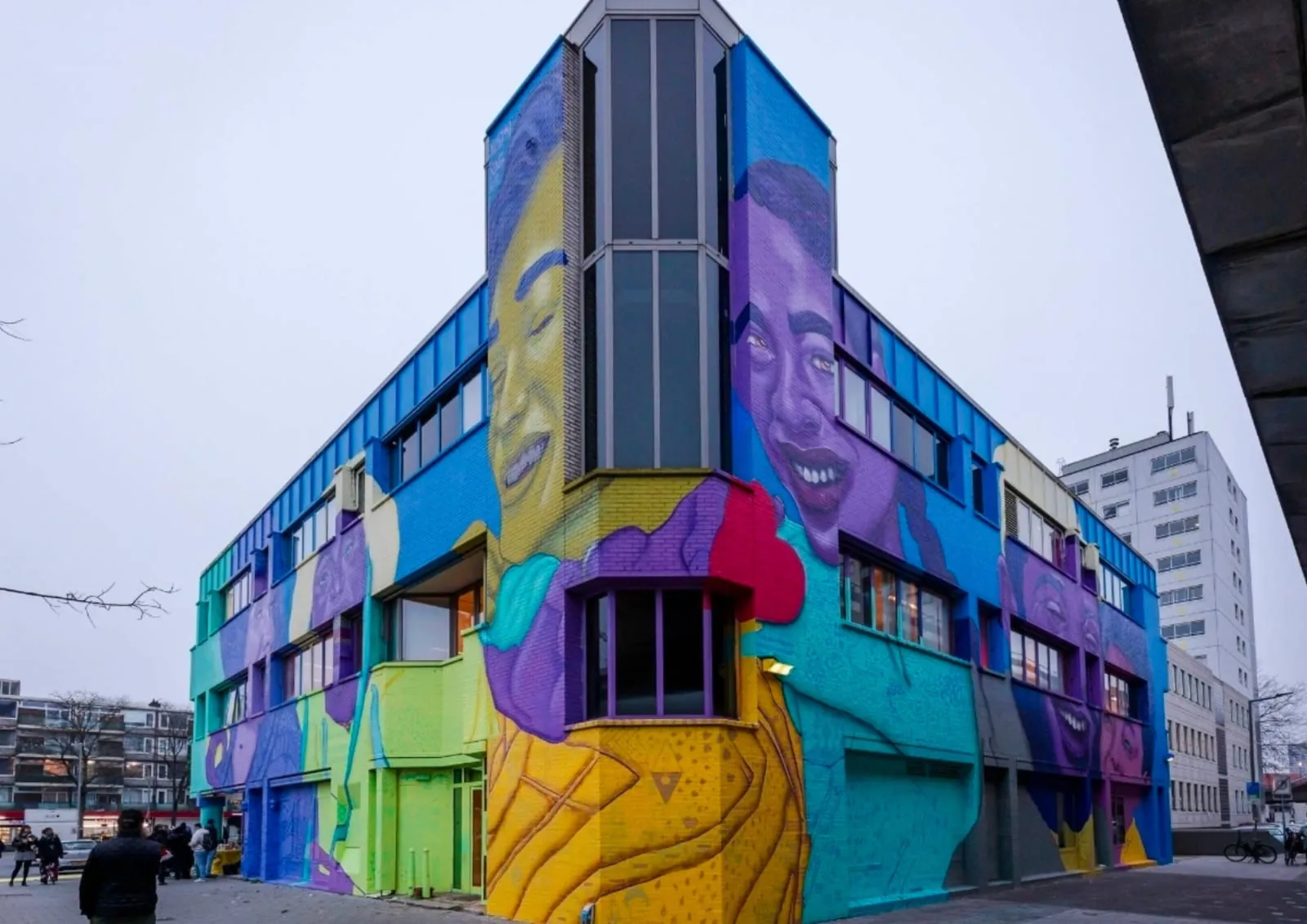
When asked whether the mural is place-specific to Zuidplein, most respondents initially said it fits the area because of its multicultural population. However, follow-up questions revealed that themes such as diversity and multiculturalism are too broad to make the mural uniquely connected to Zuidplein alone. As one collaborator noted, 'it portrays diversity, but this would fit in other diverse neighbourhoods as well, it's a generic label.' Interestingly, while respondents questioned whether the mural is uniquely tied to Rotterdam South, several were clear about where it would absolutely not fit, arguing it would evoke resistance in predominantly white and affluent neighbourhoods. Place-specificity therefore appeared to relate less to Zuidplein exclusively, and more to the broader socio-cultural character of a diverse neighbourhood.
Almost all respondents recognised different nationalities in the mural, yet when asked whether they could personally identify with one of the figures, almost everyone said no. Connection was often found instead through the emotions portrayed. The attached pride or ownership respondents felt was closely tied to involvement and therefore actor-specific: initiators, collaborators, and participants expressed stronger pride, while others tended to describe it as a pleasant visual addition without deeper personal connection.
Discussion and Conclusion
This study set out to examine what meanings stakeholders attach to a public artwork in practice and how these relate to policy claims on public art's effect. The findings show that the meanings stakeholders attach to public art are more nuanced, personally bounded, and context dependent than the claims in the analysed Rotterdam policy documents suggest.
The physical-aesthetic dimension shows the strongest connection between policy claims and stakeholder meanings. Respondents broadly experienced the mural as a visual improvement to the square, which aligns with how policy frames street art as beautifying public space. However, this appreciation is inseparable from the grey and concrete character of the surroundings, meaning the mural's visual value is dependent on the landscape it is placed in. On an economic level, respondents who attached promotional meaning to Mi Lobi Zuid did so because of the broader redevelopment context of Rotterdam South, not because of the artwork as a standalone attraction. This nuances the economic coalition's assumption that a mural itself drives visitor attraction. On the social and cultural-symbolic level, the connection between policy claims and stakeholder meanings is modest. Social interaction was not directly linked to the mural by respondents, though a lasting social norm emerged in the form of the unwritten art code protecting the building from tagging. Cultural-symbolic meanings were highly actor-specific and personally bounded, with pride and connection strongly tied to involvement in the creation process.
Three findings contribute new insights to the existing literature.
-
First, the study found a gap between policy terminology and everyday language: several respondents spontaneously referred to the commissioned mural as 'graffiti', suggesting that the firm distinction policy draws between commissioned street art and graffiti does not resonate in how the public actually describes what they see.
-
Second, the study adds nuance to literature on participatory public art (Stephens, 2006): while the creation period generated real social exchange, this connection did not persist once the mural was completed. A one-off participatory event may not be sufficient to generate lasting social impact.
-
Third, and most significantly, the study identifies spatial reimagining as a previously unidentified layer of meaning-making. Rather than only reflecting on what the artwork represents, multiple respondents spontaneously imagined new possibilities for the building, rooted in their knowledge of the place and what the neighbourhood lacks. This extends Kwon's (2004) notion of site-specificity by showing that public art can not only reflect a place but actively shift how people perceive its potential.
Overall, the findings confirm that attaching meaning to public art is fundamentally context dependent, shaped by who encounters it, the place it is situated in, and the moment in time in which it is experienced. This points to the need for more context sensitive claims in public art policy. Before commissioning a public artwork, policymakers would benefit from investing in understanding the socio-cultural characteristics and developments of an area, as the place, community, and moment in time all shape how an artwork is received. For practitioners of participatory public art, the findings highlight the importance of continuity: the social potential of participatory approaches appears to reside more in the ongoing process of making together than in the presence of the finished work.
References
- Cartiere, C., & Willis, S. (Eds.). (2008). The practice of public art. Routledge.
- Cartiere, C., & Zebracki, M. (2016). The everyday practice of public art. Routledge.
- Cheung, M., Smith, N., & Craven, O. (2021). The impacts of public art on cities, places and people's lives. The Journal of Arts Management, Law, and Society, 52(1), 37–50. https://doi.org/10.1080/10632921.2021.1942361
- Cywiński, A., & Karyń, A. (2024). Mural as a living element of urban space: Seasonal dynamics and social perception of "The Four Seasons with Kora" in Warsaw. Arts, 13(4), 117.
- Foreman-Wernet, L., & Dervin, B. (2017). Hidden depths and everyday secrets: How audience sense-making can inform arts policy and practice. The Journal of Arts Management, Law, and Society, 47(1), 47–63.
- Gemeente Rotterdam. (2021). Visie Cultuur op Zuid 2020–2030. Gemeente Rotterdam.
- Hall, T., & Robertson, I. (2001). Public art and urban regeneration: Advocacy, claims and critical debates. Landscape Research, 26(1), 5–26. https://doi.org/10.1080/01426390120024457
- Jones, R. (1995). Why do qualitative research? BMJ, 311(6996), 2.
- Kwon, M. (2004). One place after another: Site-specific art and locational identity. MIT Press.
- Lacy, S. (Ed.). (1995). Mapping the terrain: New genre public art. Bay Press.
- Mezzadri, P. (2021). Contemporary murals in the street and urban art field. Heritage, 4(3), 2515–2525.
- Miles, M. (1997). Art, space and the city: Public art and urban futures. Routledge.
- Stephens, P. G. (2006). A real community bridge: Informing community-based learning through a model of participatory public art. Art Education, 59(2), 40–46.
- Verveen, J., Bokhove, J., & El Ouali, N. (2017). Initiatiefnota: Ruimte voor street art. Gemeenteraad Rotterdam.
- Zebracki, M. (2012). Engaging geographies of public art: Indwellers, the 'Butt Plug Gnome' and their locale. Social & Cultural Geography, 13(7), 735–758.
- Zebracki, M. (2014). Public art as conversation piece: Scaling art, public space and audience. Belgeo, (3).
- Zebracki, M., & De Bekker, D. (2018). Public art for an inclusive city: Producers and publics on the social potentials and problems of flagship Vis-à-Vis community art. City & Society, 30(1), 14–44.
- Zebracki, M., Van Der Vaart, R., & Van Aalst, I. (2010). Deconstructing public artopia: Situating public art claims within practice. Geoforum, 41(5), 786–795.