Resilience LABs
Harmonious development towards holistic education in the Social Innovation specialisation

Students are experiencing more and more problems to meet the expectations held by society, and are struggling to find ways to cope with the associated mental health issues. Higher education tries to provide guidance on this, but it usually does not tackle the root of the problem. The Social Innovation specialisation has been taking a different approach to education for twenty years, and with Resilience LABs is taking the next step towards education that aligns with today’s needs.

Jacco van Mierlo is a lecturer of the Social Innovation programme of Breda University of Applied Sciences.
Problem exploration
Students experience a lot of pressure from study commitments, social activities, work, and other responsibilities. This may cause both physical and mental stress. Teaching staff are increasingly noticing that students are struggling to meet societal expectations. This picture is confirmed by research carried out by the Trimbos Institute (2021), which shows that half of students (51 per cent) experience mental health issues (such as anxiety and gloom), 12 per cent of whom to a severe degree. Students' mental well-being (resilience, positive mental health, and life satisfaction) is often out of balance. It is therefore not surprising that, partly due to the Landelijk Kader Studentenwelzijn2023-2030 (2023-2030 National Framework for Student Well-Being), universities of applied sciences are making an effort to raise awareness and offer plenty of initiatives to promote a healthy lifestyle among students. Think of one-on-one counselling, extracurricular activities such as well-being weeks, mindfulness and yoga courses, and curriculum activities such as soft-landing periods and additional coaching. These are often extracurricular activities offered outside school hours and are not mandatory. As a result, only a small percentage of students participate in them, and the real challenge of providing education that prepares all students for a healthy, balanced lifestyle, both professionally and privately, is not being addressed.

Searching for new paths
The higher education system has difficulty exploring alternative approaches that are more in line with new demands from society. In education, it is time to let go a little more and listen to the younger generation, going beyond setting up staff and student participation councils and asking students for their opinions in evaluations and surveys. It is about working with students to develop education that integrates their desire for an understanding society. A society in which their concerns are recognised and in which they find the support they need to face the future with resilience. By doing so, we offer students the opportunity to meet their need for a positive outlook and a sense of agency: the ability to exercise control over their own lives and living conditions, and to contribute to substantial 'alternative futures'.
The holistic approach focuses on the student’s entire development - intellectually, socially, emotionally, physically, and spiritually.
A perspective that aligns with the above needs is the holistic approach. This approach focuses on the students’ full development – intellectually, socially, emotionally, physically, and spiritually. Instead of emphasising only academic performance, this approach integrates different aspects of living and learning, such as creativity, social skills, and emotional well-being. This helps students to develop a feeling of connectedness and well-being in addition to qualification and socialisation, which is essential to ‘feeling comfortable in their skin’. The importance of holistic education lies in promoting a balanced and harmonious development. If all facets of being human are paid attention to in education, students are encouraged to explore and make use of their full potential. This leads to self-aware, resilient and happy individuals who are better prepared for the challenges of life and therefore, their working lives too.
Harmonious development at Performatory
Within Performatory, we take a holistic approach that is better suited to today's needs. Performatory is a physical environment within the Social Innovation specialisation, where there is room for education based on different pedagogical principles. Room for seeing, thinking and doing things differently, thereby contributing to students' mental and physical resilience.
Within Performatory, the Harmonious Development of Students in Higher Education project focuses on holistic principles such as attention to the whole person, individual needs and diversity, and connection with social issues. Ways are being sought, together with students, to pay more attention to well-being in the curriculum. The preliminary research led to a focus on ‘sense of meaning’, ‘sense of purpose’, and ‘sense of belonging’ in order to improve students' mental and physical health.
‘Sense of meaning’ evolves around values that are important for students and their personal development, relationships with others, and the world. Students search for what is important, asking questions such as: What is my essence as a person? What do my actions mean?

This gives direction to their ‘sense of purpose’, which focuses on students' goals, such as improving mental and physical health. We create space for students to set their own goals and experiment, so they can learn and grow.
‘Sense of belonging’ is about the feeling of being accepted and appreciated within a group. This is crucial for the students’ self-confidence and involvement. Therefore, a lot of attention is paid to creating a learning environment where students feel at home, with many social activities aimed at Performatory and in which we involve students in developing education.
In the project, the focus on the said items requiring attention led to all kinds of experiments, such as conversations with students about student well-being (the so-called ‘biscuit tin’ conversations); experiments with ‘entry and exit tasks’ during our labs to enter into discussions about their well-being in a different way; organising ‘walky-talkies’ during which topics that students encounter are discussed during walks; and a ‘fast dopamine challenge’ in which students are encouraged to avoid ‘fast dopamine kicks’ for a week. Eventually, this led to a Resilience LABs Cycle being developed, a step towards holistic education in which attention to developing resilient students is organically woven into the curriculum.
Resilience LABs
In March 2025 we started the first cycle of ten ‘Resilience LABs’ based on the ‘Wheel of Life’ and the ‘PERMA(H) model’ from positive psychology, both models focus on how to improve a balanced, resilient and satisfactory life (see Figure 1). The LABs consist of weekly 90-minute sessions and are fully organised by students. The LABs focus on understanding of and contribution to a personal behavioural change with regard to their own well-being, and are intended for both students and lecturers.
We take a different approach within Performatory, in a way that aligns with today’s needs.
Each Resilience LAB has a standard set-up and contains: preparation; introduction; explanation; core in the shape of a leisure activity (such as boxing or painting); judgement-free feedback; and closing off. Participants make preparations, discuss the topic, experience it by carrying out activities, and share their insights without any judgement. This promotes personal development and offers new perspectives on the personal goals that were defined at the beginning of the cycle.
It is important that a safe environment should be created during the Resilience Labs in which participants can be themselves. Although we want to work with as few rules as possible, we agree that personal matters discussed in the LAB will not be shared outside the lab and that you do not have to share anything if you do not feel comfortable doing so. Participation in the activities is mandatory; just watching is not allowed. This prevents participants from feeling observed and being less open.
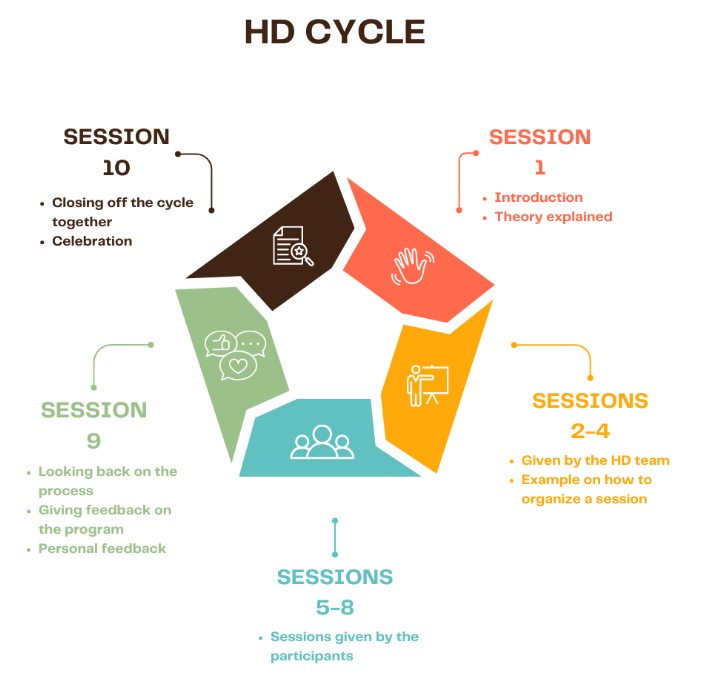
The students’ responses have been largely positive so far, and it is great to see that they are contributing ideas to improve the next cycle of Resilience LABs and expand it to other students.
Conclusion
With the Resilience LABs, the Performatory has taken the next step towards a more harmonious curriculum. This is a curriculum component in which both students and lecturers actively work on gaining insight into and contributing to personal behavioural change with regard to their own well-being. The next step is to integrate this approach into other curriculum components.
Sources
- RIVM, Trimbos-instituut, & GGD GHOR Nederland. (2021). Monitor Mentale Gezondheid en Middelengebruik Studenten Hoger Onderwijs, Deelrapport I: Mentale gezondheid van studenten in het hoger onderwijs. RIVM.
- Depla, P., Dorhout, A., van Genderen, T., Horabail Prabhakara, S., Howard, N., Naglé, S., Rutten, A., & Wilderink, S. (2023). Finding Meaning in Academia: Radboud Honours Project: Sense of Purpose and Student Well-Being. Radboud Honours Academy.
Dit artikel is eerder verschenen in Uncover, een uitgave van het domein Leisure & Events van de Breda University of Applied Sciences. Nieuwsgierig naar de andere artikelen uit Uncover? Stuur dan een mailtje naar ton@nrit.nl